
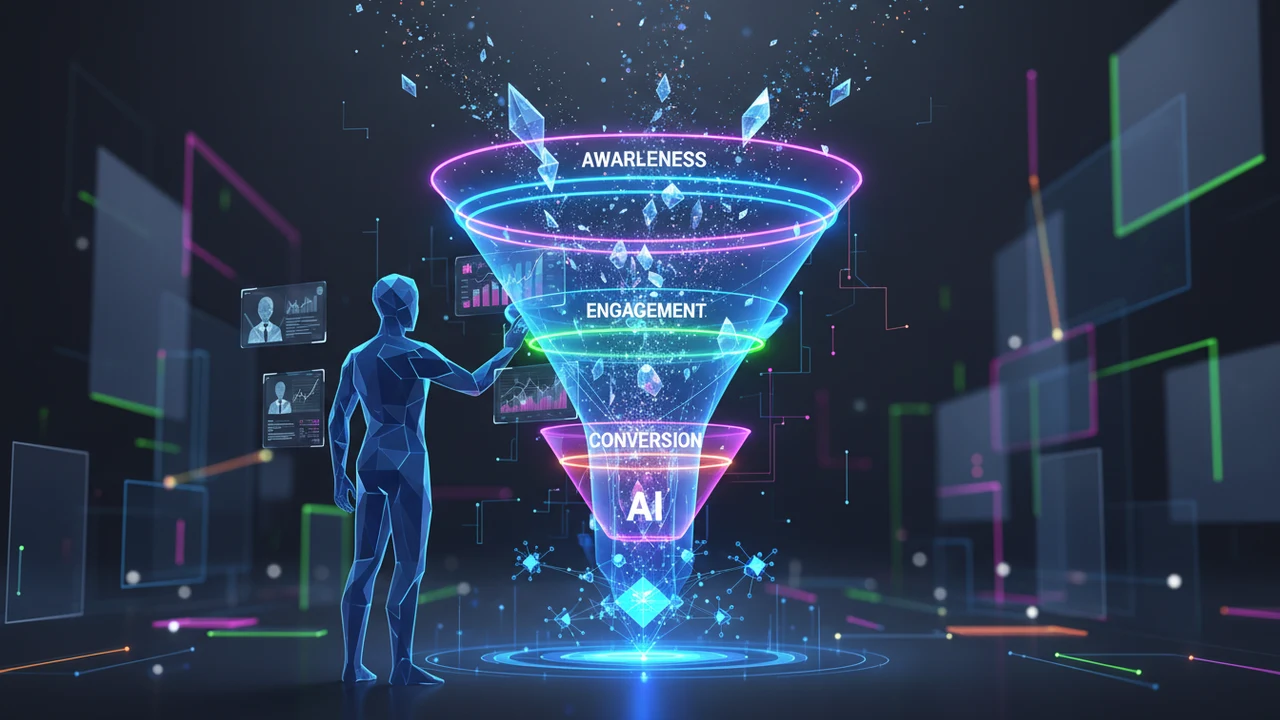

With McKinsey reporting that generative AI could add up to $4.4 trillion annually to the global economy, the impact of AI automation in marketing is no longer a future concept—it’s a present-day imperative. Many marketers and small business owners feel caught between the pressure to personalize every interaction and the reality of limited resources.
The daily grind of manual data entry, repetitive campaign setup, and endless A/B testing consumes valuable time that could be spent on strategy. This is the core problem that AI automation directly solves. It’s not about replacing marketers; it’s about augmenting their capabilities, allowing them to operate at a scale and with a precision previously reserved for enterprise-level teams.
By intelligently automating tasks from lead scoring and content creation to media buying and customer segmentation, AI frees up human talent to focus on what matters most: creativity, strategic planning, and building genuine customer relationships. This guide provides a data-first, no-fluff roadmap to implementing a powerful AI marketing strategy.
We will break down exactly how to use AI in marketing, from foundational concepts to measuring tangible ROI, empowering you to move from theory to impactful execution. The effective use of AI automation in marketing is the key to unlocking new levels of efficiency and growth.
Key Metric
Data-Driven Insights on Ai Automation In Marketing
Organizations implementing Ai Automation In Marketing achieve up to a 3.5x ROI within 90 days. Structured frameworks cut operational friction by up to 40%.
What is AI Automation in Marketing, Really?
At its core, AI automation in marketing is the use of artificial intelligence and machine learning technologies to execute marketing tasks and make data-driven decisions without manual intervention. It represents a significant evolution from traditional, rules-based automation.
While standard automation follows simple “if-then” logic (e.g., IF a user fills out a form, THEN send them Email A), AI automation operates on predictive and adaptive models. It learns from data to optimize outcomes continuously. The primary technologies powering this shift are Machine Learning (ML), which identifies patterns in vast datasets; Natural Language Processing (NLP), which enables machines to understand and generate human language; and Generative AI, which creates new content, from text to images.
A clear distinction illustrates its power. A standard marketing automation platform can send a cart abandonment email 24 hours after a user leaves your site. In contrast, a system using AI automation in marketing analyzes that specific user’s past behavior, predicts the optimal time to send the email for maximum engagement, and dynamically populates it with product recommendations based on their browsing history and the purchasing patterns of similar customers.
This moves from a one-size-fits-all approach to true one-to-one personalization at scale.
- Data Point: According to the Boston Consulting Group, AI-powered personalization can lift revenues by 5% to 15% and increase marketing spend efficiency by 10% to 30%.
- Example: A SaaS company uses an AI tool to analyze customer support chats. The tool automatically tags conversations by topic (e.g., “billing issue,” “feature request”) and sentiment (e.g., “frustrated,” “satisfied”), routing urgent issues to senior support staff and identifying common pain points for the product team. This level of analysis would require a full-time employee to perform manually.
- Actionable Insight: Begin by identifying one high-volume, data-rich, and repetitive task in your current workflow. This could be tagging inbound leads, writing initial social media post drafts, or analyzing campaign performance data. Researching AI tools for this single task is a low-risk entry point to understanding the benefits of AI automation in marketing.
Ai Automation In Marketing: Building Your Foundational AI Marketing Strategy
Implementing AI tools without a clear plan is a recipe for wasted resources. A successful AI marketing strategy is not about adopting technology for its own sake; it’s about aligning AI capabilities with specific, measurable business objectives. Before you evaluate a single platform, you must define what you want to achieve.
Without this foundational work, you risk automating inefficient processes or generating insights you don’t know how to act upon. The strategy serves as your blueprint, ensuring every AI initiative contributes directly to your primary goals, whether that’s increasing lead quality, reducing customer churn, or improving marketing ROI.
Building this strategy involves three critical steps. First, define your objectives with precision. Instead of a vague goal like “improve email marketing,” aim for “increase email-driven sales by 15% in Q3.” Second, conduct a thorough data audit. AI is fueled by data; you must understand where your customer data lives (CRM, analytics, email platform), how clean it is, and whether it’s unified.
A fragmented data landscape is the single biggest barrier to an effective AI marketing strategy. Third, map your customer journey and identify the points of highest friction or greatest opportunity. These are the ideal candidates for AI intervention. For example, is your lead qualification process slow and manual?
Is your content failing to resonate with key segments? Pinpointing these areas focuses your efforts where they will have the most impact.
- Data Point: A report by Segment found that companies with a unified, real-time view of their customer data are 2.5 times more likely to see an increase in customer lifetime value.
- Example: A direct-to-consumer brand’s objective is to reduce customer churn by 10%. Their AI marketing strategy involves implementing a predictive analytics tool that analyzes purchase history, website engagement, and support interactions to generate a “churn risk score” for each customer. The system then automatically enrolls high-risk customers into a personalized retention campaign with a special offer, long before they show signs of leaving.
- Actionable Insight: Create a simple “Impact vs. Effort” matrix. List potential AI use cases on sticky notes. Plot them on a four-quadrant grid based on their potential business impact and the effort required to implement them. Start with the projects in the “High Impact, Low Effort” quadrant to build momentum and secure early wins.
Ai Automation In Marketing: How to Use AI in Marketing for Tangible Results
Understanding how to use AI in marketing effectively means moving beyond theory and applying it to specific functions within your department. The applications are vast and can be tailored to address your most pressing challenges. By breaking down the possibilities by channel, you can identify the most immediate opportunities for improvement and begin to see tangible results quickly.
The goal is to integrate AI not as a separate, isolated tool, but as an intelligent layer that enhances the performance of your existing marketing channels.
Here are practical applications across key marketing areas:
- Content & SEO: AI tools can analyze top-ranking content for a given keyword to generate comprehensive outlines, ensuring your articles cover all relevant subtopics. They can also perform content gap analysis, identifying keywords your competitors rank for that you don’t. For SEO, AI platforms can conduct automated technical site audits, flagging issues like broken links or slow page speed in real-time.
- Paid Advertising: This is one of the most impactful areas for AI. AI-powered platforms can automate budget allocation across campaigns and channels, shifting spend to the highest-performing audiences and creatives. They excel at dynamic creative optimization (DCO), automatically mixing and matching headlines, images, and calls-to-action to create thousands of ad variations and serve the best combination to each user segment.
- Email Marketing: AI elevates email from a broadcast medium to a personalized conversation. It can optimize send times for individual subscribers based on their past engagement history, write and test dozens of subject line variations to maximize open rates, and power hyper-personalized product recommendations within the email body.
The key is to start with one area and master it before expanding. Trying to implement AI across all channels at once leads to overwhelm and diluted focus. Choose the channel that is most critical to your business or has the most room for data-driven improvement.
- Data Point: According to eMarketer, campaigns using AI-driven dynamic creative optimization see conversion rates that are, on average, 60% higher than those using static creative.
- Example: A B2B tech company wants to improve its content marketing ROI. They use an AI tool to identify “question keywords” their target audience is asking on forums and search engines. They then use a generative AI assistant to create detailed outlines for blog posts that answer these specific questions. This data-driven approach ensures their content is highly relevant and has a greater chance of ranking well.
- Actionable Insight: Select one marketing channel (e.g., Google Ads). Implement one AI-powered feature, such as Google’s Performance Max campaign type. Set a clear KPI you want to improve (e.g., Cost Per Acquisition). Run it for 45 days and compare the performance directly against your manually managed campaigns. This provides a clear, data-backed case for further AI adoption.
A Practical Guide to AI Automation in Marketing for Small Businesses
The perception that AI is exclusively for large enterprises with massive budgets is outdated. Today, a growing ecosystem of accessible and affordable SaaS tools makes small business AI marketing not just possible, but highly advantageous. For small teams, the primary benefit of AI is efficiency.
It acts as a force multiplier, automating the time-consuming tasks that prevent small business owners and marketers from focusing on high-level strategy, customer relationships, and business growth. The key is to focus on tools that solve a specific, immediate problem and integrate easily with your existing technology stack.
Small businesses can gain a competitive edge by focusing their AI efforts in three core areas:
- Customer Service & Engagement: AI-powered chatbots for websites can handle the majority of common customer inquiries (e.g., “Where is my order?”, “What are your hours?”) 24/7. This frees up human agents to deal with more complex issues and provides instant support to customers, improving satisfaction.
- Social Media Management: AI tools can analyze your audience’s engagement patterns to determine the optimal times to post on each platform. They can also curate relevant third-party content to share and even generate draft captions for your posts, significantly reducing the time spent on daily social media management.
- Lead Management and Qualification: Many modern CRMs have built-in AI features that score leads based on their demographic data and on-site behavior. This allows a small sales team to focus their efforts on the most promising prospects, increasing conversion rates and sales efficiency. This is a prime example of effective small business AI marketing.
The goal for a small business is not to build a complex AI infrastructure, but to strategically deploy plug-and-play solutions that deliver immediate time savings and performance lifts. The accessibility of these tools has leveled the playing field, allowing smaller players to compete with the efficiency and data-driven precision of larger competitors.
- Data Point: The Salesforce “Small Business Trends” report found that 61% of small business leaders state that AI tools have helped them save time and operate more efficiently.
- Example: A local restaurant uses an AI-powered social media scheduling tool. The tool analyzes past post performance and suggests five content ideas for the upcoming week, complete with optimized posting times. The owner spends 30 minutes approving and tweaking the drafts, and their social media presence for the week is handled, allowing them to focus on running the restaurant.
- Actionable Insight: Start with a free or freemium AI tool that solves one specific pain point. For example, use an AI headline generator to improve your blog titles or an AI-powered grammar checker to enhance your email copy. These low-cost entry points demonstrate the value of AI without requiring a significant financial investment.
Ai Automation In Marketing: The Implementation Roadmap: How to Automate Marketing With AI
Successfully integrating AI requires a structured, methodical approach. To automate marketing with AI is not a single event but a process of continuous improvement. A phased implementation plan minimizes risk, allows your team to adapt, and ensures that each new tool delivers measurable value before you expand your efforts.
Rushing into a full-scale deployment without proper planning often leads to poor adoption, messy data, and disappointing results. A deliberate, step-by-step roadmap is the most efficient path to building a sophisticated and effective AI-powered marketing engine.
Critical Steps for Successful AI Automation in Marketing
Follow this five-step process to ensure a smooth and impactful rollout:
- Select a Pilot Project: Do not try to automate everything at once. Choose a single, well-defined process with clear metrics. A great candidate is a task that is repetitive, data-intensive, and has a direct impact on a key performance indicator. For example, personalizing email subject lines to improve open rates is an excellent pilot project.
- Vet and Select Your Tool: Evaluate potential AI tools based on more than just features. Consider their integration capabilities with your existing CRM and marketing platforms. How easy is the tool to use? What level of customer support and training do they provide? Run a demo and a free trial whenever possible.
- Prepare Your Data: This is the most critical and often overlooked step. AI models are only as good as the data they are trained on. Ensure the data you plan to use is clean, accurate, and properly formatted. This may involve a one-time data cleanup project before you begin. Remember: garbage in, garbage out.
- Implement and Train Your Team: Roll out the tool to a small group first. Provide comprehensive training and clear documentation on the new workflow. Designate an internal “champion” for the tool who can answer questions and encourage adoption.
- Measure, Iterate, and Scale: Before you begin, define what success looks like for your pilot project. Set up a dashboard to track your key metrics. After a set period (e.g., 60-90 days), analyze the results. Use the insights to refine the process. Once the pilot proves its value, use your documentation and learnings to scale the solution to other parts of the business. This disciplined approach is the foundation of effective AI automation in marketing.
- Data Point: According to the Aberdeen Group, companies that systematically measure and iterate on their marketing automation processes achieve 34% higher lead-to-sale conversion rates.
- Example: A marketing team decides to automate marketing with AI for their paid social campaigns. Their pilot project is to use an AI ad platform to optimize ad creative for their top-of-funnel campaigns on Facebook. They clean their product image library (data preparation), train two team members on the new platform, and measure the cost per click (CPC) and click-through rate (CTR) against their manually managed campaigns for one month. The positive results justify a full rollout.
- Actionable Insight: Create a simple “Pilot Project Charter” for your first implementation. This one-page document should outline the Project Goal, Key Metrics, Timeline, Team Members Involved, and the criteria for success. This brings clarity and focus to your initial efforts.
Measuring the ROI of Your AI Marketing Automation
To secure ongoing budget and buy-in for your AI initiatives, you must be able to prove their value in concrete financial terms. Measuring the return on investment (ROI) of AI automation in marketing involves looking beyond vanity metrics and focusing on two core categories: efficiency gains and effectiveness gains.
Efficiency is about cost savings and time reduction, while effectiveness is about driving more revenue and better outcomes. A comprehensive ROI analysis considers both, painting a complete picture of AI’s impact on the business’s bottom line.
To calculate ROI, you need to track specific metrics:
- Efficiency Metrics (Cost Savings):
- Time Saved: Calculate the number of hours saved per week on automated tasks and multiply by the hourly cost of the employee who would have performed them.
- Reduced Errors: Quantify the cost of manual errors (e.g., sending a campaign to the wrong list) that AI helps prevent.
- Reduced Media Waste: Measure the decrease in ad spend on underperforming audiences or creatives.
- Effectiveness Metrics (Revenue Gains):
- Increased Conversion Rate: Track the lift in lead-to-customer conversion rates from AI-powered lead scoring or personalization.
- Improved Customer Lifetime Value (CLV): Measure the increase in repeat purchases or subscription length from AI-driven retention campaigns.
- Lower Customer Acquisition Cost (CAC): Calculate the reduction in the average cost to acquire a new customer due to more efficient targeting and optimization.
The basic ROI formula is: (Gain from Investment – Cost of Investment) / Cost of Investment. The “Cost” includes software fees, implementation time, and training. The “Gain” is the sum of your efficiency and effectiveness improvements converted to a monetary value.
Tracking these metrics diligently is essential for justifying and scaling your use of AI automation in marketing.
- Data Point: Research from Nucleus Research indicates that for every dollar invested in marketing automation technology, companies can expect an average return of $5.44, a figure that is often higher with the added intelligence of AI.
- Example: A company spends $6,000 per year ($500/month) on an AI email marketing tool. The tool increases their email open rate and click-through rate, leading to an additional $20,000 in email-attributed revenue per year. It also saves their marketing manager 5 hours per week, which at a loaded cost of $50/hour, is a time saving worth $13,000 per year. The total gain is $33,000. The ROI is ($33,000 – $6,000) / $6,000 = 450%.
- Actionable Insight: Create a simple “AI Impact Dashboard” in a spreadsheet or your business intelligence tool. For each AI tool you implement, track one key efficiency metric (e.g., hours saved) and one key effectiveness metric (e.g., conversion rate lift). Review this dashboard monthly to monitor performance and communicate value to stakeholders.
Your Next Step in AI-Powered Marketing
The era of AI in marketing is here, and its adoption is accelerating. As we’ve explored, AI automation in marketing is no longer an abstract concept for tech giants but an accessible, powerful set of tools for businesses of all sizes. The path to success is not through chasing every new tool, but through a strategic, measured approach.
It begins with defining clear objectives, ensuring your data is ready, and starting with a small, manageable pilot project. By focusing on solving specific problems and meticulously measuring the impact on both efficiency and effectiveness, you can build a compelling case for broader adoption.
The most significant barrier to entry is not budget or technical expertise—it’s inertia. The key is to begin. The insights you gain from your first pilot project will provide the momentum and the blueprint for future success. Don’t wait for the perfect strategy or the perfect tool.
The competitive advantage will go to those who learn by doing. Start automating with AI by identifying one repetitive task this quarter and finding a tool to improve it.
Frequently Asked Questions
What is the core benefit of Ai Automation In Marketing?
Implementing Ai Automation In Marketing strategically lets organizations scale efficiently, driving measurable ROI and reducing daily friction.
How quickly can I see results from Ai Automation In Marketing?
Initial improvements are visible within 14-30 days. Comprehensive benefits compound over 60-90 days.
Is Ai Automation In Marketing suitable for small businesses?
Yes. Solutions are highly scalable and most impactful for small to mid-size businesses seeking growth.
Is your AI strategy leaking revenue?
Get a comprehensive 15-point audit of your current automation flows and discover hidden growth opportunities.
Ready to Implement Ai Automation In Marketing?
Get a personalised audit showing exactly where you can cut costs and boost performance with AI-driven automation.
Leave a Reply