

Key Metric
Data-Driven Insights on Odoo Headless Integration
Organizations implementing Odoo Headless Integration achieve up to a 3.5x ROI within 90 days. Structured frameworks cut operational friction by up to 40%.
Understanding the Strategic Imperative for Odoo Headless Integration
The global market for headless commerce platforms is projected to reach over $1.6 billion by 2027 (industry estimate), demonstrating a clear enterprise-wide shift towards flexible, API-driven solutions. This growth directly responds to the limitations of monolithic systems in meeting modern omnichannel customer journey demands.
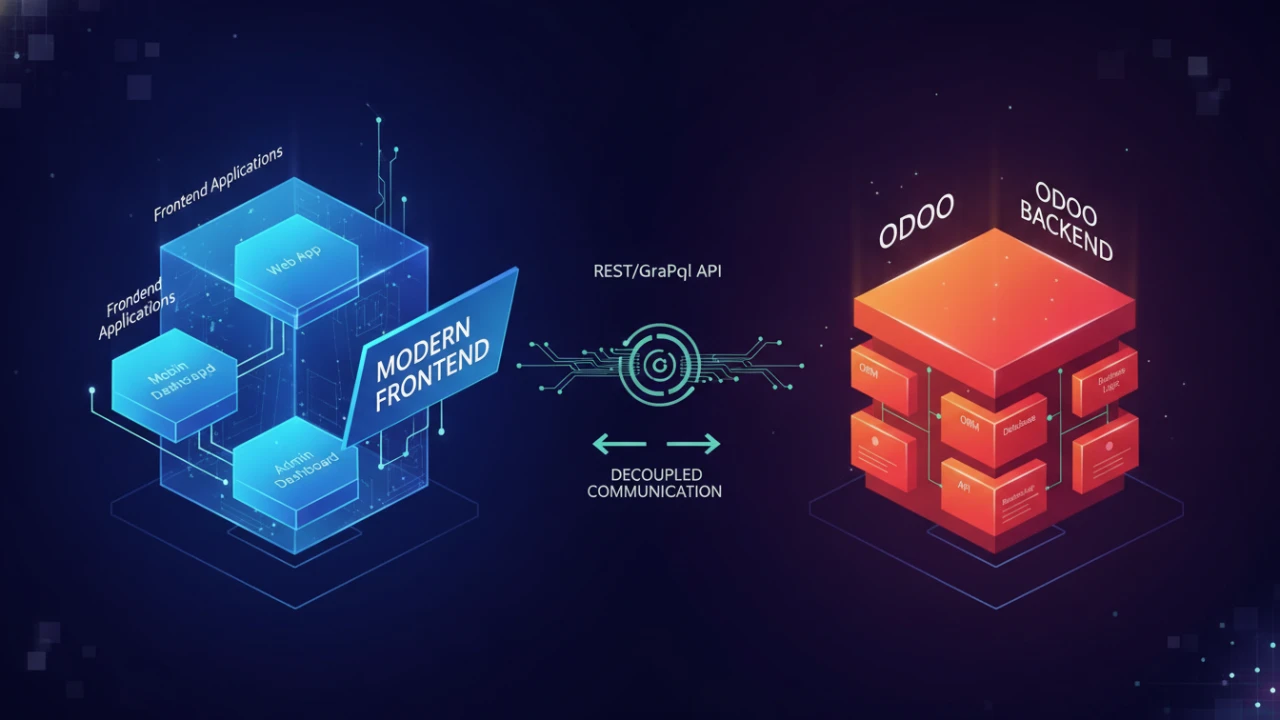
For organizations using Odoo, a robust ERP, CRM, and business management suite, the strategic imperative for odoo headless integration stems from the need to maintain Odoo’s powerful backend functionalities while liberating the frontend experience.
A decoupled Odoo backend allows businesses to craft highly specific user interfaces and experiences, unconstrained by Odoo’s default rendering engine. This separation is crucial for enterprises operating in complex digital ecosystems, where a single, unified customer experience across web, mobile, IoT, and emerging channels is paramount.
Consider a large manufacturing enterprise managing diverse product lines and B2B customer portals. A traditional Odoo setup might struggle to deliver the bespoke, high-performance interfaces required for complex product configurators or specialized partner dashboards without significant customization to Odoo’s core.
By implementing an odoo headless integration, this enterprise can use Odoo for its inventory management, sales orders, and CRM, while building a custom frontend using modern frameworks like React or Vue.js.
This approach enhances user experience, improves site performance, reduces frontend development cycles, and allows for independent scaling of frontend and backend services. The actionable insight here is to conduct a thorough analysis of current digital touchpoints and future experience requirements.
If your enterprise anticipates frequent UI/UX changes, demands exceptional performance, or needs to support a multitude of customer interaction points, a headless Odoo architecture presents a compelling strategic advantage. It enables greater innovation and responsiveness without compromising the stability of your core business operations.
Architectural Principles of Odoo Headless Integration and a Decoupled Odoo Backend
Achieving a truly decoupled Odoo backend requires a deep understanding of architectural principles that prioritize API-first design, data integrity, and service independence. At its core, a headless Odoo architecture positions Odoo as a powerful data and business logic engine, exposing its functionalities through well-defined APIs.
While Odoo provides XML-RPC and JSON-RPC APIs out-of-the-box, enterprise-grade odoo headless integration often involves building a robust middleware layer or custom RESTful APIs on top of Odoo’s native capabilities. This layer acts as a translator and orchestrator, optimizing data retrieval, handling complex queries, and enforcing security policies before data reaches the frontend application.
Performance metrics from API-driven architectures consistently show reduced latency and improved throughput compared to traditional server-side rendering, directly benefiting user experience and operational efficiency.
The key to a successful odoo headless integration lies in meticulous data modeling and API design. Enterprises must identify the critical data entities (e.g., products, customers, orders) and business processes that need to be exposed externally.
Each API endpoint should be designed for specific use cases, ensuring efficient data exchange and minimal overhead.
For instance, a microservices approach might involve separate services for product catalog management, customer authentication, and order processing, all communicating with the Odoo backend via its internal APIs. This modularity enhances scalability and isolates potential failures, improving overall system resilience.
An actionable insight for lead developers is to prioritize a comprehensive API documentation strategy from the outset. Consistent documentation for every endpoint, including request/response formats, authentication methods, and error handling, is essential for accelerating frontend development and ensuring long-term maintainability of the decoupled Odoo backend.
This structured approach to API development forms the bedrock of a flexible and scalable headless system.
Odoo Headless Integration: Implementing Custom Frontend Odoo Experiences With Headless Integration
The primary driver for odoo headless integration is the ability to create unparalleled custom frontend experiences. With Odoo serving as the backend data source, enterprises gain the freedom to select any modern frontend technology stack, including popular frameworks like React, Vue.js, Angular, or even static site generators.
This flexibility empowers development teams to craft highly interactive, performant, and brand-aligned user interfaces that are optimized for specific audiences and devices.
Research indicates that a 1-second improvement in page load time can increase conversions by 7%, highlighting the direct impact of frontend performance on business outcomes. A custom frontend built on a headless Odoo architecture can significantly outperform traditional Odoo web interfaces in terms of speed and responsiveness, delivering a superior user journey.
For instance, a B2B enterprise requiring a sophisticated customer portal with real-time order tracking, personalized dashboards, and complex product configurators can use a custom frontend Odoo solution. The frontend application would consume data from Odoo’s APIs, rendering dynamic content and enabling interactive functionalities that might be challenging or resource-intensive to implement within Odoo’s native framework.
This separation allows for independent deployment and scaling of the frontend, ensuring that UI updates or traffic spikes do not impact the Odoo backend’s stability.
An actionable insight for enterprise architects is to establish a clear contract between the frontend and backend teams regarding API specifications and data formats. Employing tools like OpenAPI (Swagger) for API definition and validation can streamline communication and prevent integration issues.
Furthermore, implementing robust caching strategies on the frontend, using Content Delivery Networks (CDNs) for static assets, and optimizing image delivery are critical best practices to maximize the performance benefits derived from a custom frontend Odoo implementation, ensuring a truly exceptional user experience.
Odoo Headless Integration: Odoo Headless ECommerce: Enhancing Digital Commerce Capabilities Via Headless Odoo Integration
The landscape of digital commerce demands agility, personalization, and seamless omnichannel experiences. Odoo’s robust sales, inventory, and CRM modules make it an excellent backend for eCommerce operations, but its default frontend may not always meet the sophisticated demands of modern B2B or high-volume B2C platforms.
This is where odoo headless ecommerce becomes a powerful strategy.
By decoupling the storefront from Odoo’s backend, businesses can build highly customized, lightning-fast eCommerce sites that deliver unparalleled user experiences and conversion rates. Industry reports show that B2B eCommerce is projected to reach $1.8 trillion by 2023, underscoring the critical need for scalable and flexible commerce solutions that can adapt to evolving buyer expectations.
Implementing odoo headless ecommerce allows enterprises to use Odoo for its core commerce functionalities—product information management (PIM), order processing, inventory synchronization, customer management, and pricing rules—while delivering a bespoke shopping experience through a custom frontend.
This could involve integrating with specialized search engines, advanced recommendation engines, or personalized content delivery systems that are difficult to embed within a monolithic Odoo framework. For example, a global retailer might use Odoo for its multi-company and multi-currency capabilities, while presenting a localized, highly interactive storefront built with Next.js or Gatsby.js.
The actionable insight for lead developers is to focus on optimizing the API layer for critical eCommerce workflows, such as product catalog retrieval, shopping cart management, and checkout processes. Ensuring efficient data transfer and robust error handling for these high-traffic operations is paramount.
Furthermore, consider implementing webhooks in Odoo to trigger real-time updates to the frontend, such as inventory changes or order status modifications, maintaining data consistency and providing a dynamic user experience in your odoo headless ecommerce solution.
Security and Scalability Considerations for Odoo Headless Integration
Implementing an odoo headless integration introduces distinct security and scalability considerations that demand rigorous attention from enterprise architects. While the decoupled architecture offers inherent advantages in isolating components, it also expands the attack surface by exposing APIs.
Data breaches cost enterprises an average of $4.45 million in 2023, emphasizing the critical importance of robust security protocols.
For a headless Odoo setup, securing the API layer is paramount. This involves implementing strong authentication mechanisms, such as OAuth 2.0 or API keys, coupled with granular authorization controls to ensure that only authorized applications and users can access specific Odoo data and functionalities.
Regular security audits, penetration testing, and vulnerability assessments of the API endpoints and the frontend application are non-negotiable practices.
Scalability in an odoo headless integration is achieved through the independent scaling of frontend and backend components. The Odoo backend can be scaled horizontally by adding more application servers and optimizing database performance, while the frontend application can use serverless functions, container orchestration (e.g., Kubernetes), and global CDNs to handle varying traffic loads.
For instance, during peak sales periods, an eCommerce frontend can scale independently without impacting Odoo’s core ERP operations.
An actionable insight for lead developers is to design the API layer with caching mechanisms at various levels—API gateway, application-level, and client-side—to reduce the load on the Odoo backend and improve response times. Implementing rate limiting on API endpoints prevents abuse and protects against denial-of-service attacks.
Furthermore, adopting a robust monitoring and alerting strategy for both the Odoo backend and the frontend application is crucial for proactively identifying and addressing performance bottlenecks or security anomalies, ensuring the continuous availability and integrity of your headless Odoo solution.
The Development Lifecycle and Team Structure for Odoo Headless Integration Projects
The development lifecycle for an odoo headless integration project diverges significantly from traditional Odoo implementations. It demands a refined approach to team structure, tooling, and continuous delivery. Agile methodologies are particularly well-suited for these projects, fostering iterative development, rapid feedback loops, and adaptability to evolving requirements.
Data indicates that organizations adopting DevOps practices achieve 200x more frequent deployments and 3x lower change failure rates, underscoring the efficiency gains possible with a streamlined development pipeline. A successful headless Odoo project requires cross-functional teams comprising Odoo backend specialists, API developers, and dedicated frontend engineers, all collaborating closely from the inception of the project.
The team structure typically involves a core Odoo team responsible for configuring and extending Odoo’s backend, a middleware/API team focused on exposing Odoo data and logic securely and efficiently, and one or more frontend teams building the user interfaces. Effective communication and shared understanding of the overall architecture are paramount.
An actionable insight for CTOs and lead developers is to establish a robust CI/CD pipeline for both the Odoo backend customizations and the independent frontend applications.
This pipeline should automate testing, deployment, and monitoring, ensuring consistent quality and accelerating time-to-market for new features. Version control systems (e.g., Git) should be meticulously managed across all repositories. Furthermore, adopting an API-first development approach, where API contracts are defined and agreed upon before implementation begins, minimizes integration friction and enables parallel development efforts.
This structured approach to the development lifecycle and team organization is critical for navigating the complexities of an odoo headless integration and delivering a high-quality, scalable solution.
Frequently Asked Questions About Odoo Headless Integration
What are the primary benefits of Odoo headless integration for enterprises?
Odoo headless integration offers several significant benefits, primarily enhanced flexibility, superior performance, and improved scalability. Enterprises can create highly customized user experiences across various digital channels without being constrained by Odoo’s default frontend.
This leads to faster page load times, better user engagement, and higher conversion rates. Furthermore, the decoupled architecture allows independent scaling of frontend and backend components, ensuring resilience during peak loads and facilitating easier maintenance and updates.
It also future-proofs the digital infrastructure, enabling seamless integration with emerging technologies and diverse third-party services, driving continuous innovation.
How does Odoo headless integration impact existing Odoo modules and customizations?
Odoo headless integration primarily impacts how data and business logic from existing Odoo modules are exposed and consumed. Core Odoo modules (e.g., Sales, Inventory, CRM) continue to function as the backend source of truth. Existing customizations within Odoo remain intact, but their functionalities need to be exposed via APIs for the headless frontend to interact with them.
This often requires developing a custom API layer or extending Odoo’s native APIs to ensure all necessary data and processes are accessible. The goal is to utilize Odoo’s robust backend capabilities while presenting a custom interface, minimizing direct modifications to Odoo’s core frontend rendering.
What technical skills are essential for implementing a successful Odoo headless integration?
Implementing a successful Odoo headless integration requires a diverse skill set. On the backend, expertise in Odoo development (Python, Odoo ORM, API extensions) is crucial. For the API layer, strong knowledge of RESTful API design, data serialization, and potentially GraphQL is beneficial.
Frontend development skills are paramount, including proficiency in modern JavaScript frameworks like React, Vue.js, or Angular, along with expertise in HTML, CSS, and state management. Additionally, knowledge of cloud platforms, DevOps practices (CI/CD), database optimization, and robust security protocols are essential for building and maintaining a scalable, secure headless Odoo solution.
Can Odoo headless integration support multi-channel and omnichannel strategies?
Odoo headless integration is inherently designed to support multi-channel and omnichannel strategies. By decoupling the frontend, enterprises can build distinct user interfaces optimized for web, mobile apps, IoT devices, smart displays, or even voice interfaces, all powered by a single, consistent Odoo backend
Frequently Asked Questions
What is the core benefit of Odoo Headless Integration?
Implementing Odoo Headless Integration strategically lets organizations scale efficiently, driving measurable ROI and reducing daily friction.
How quickly can I see results from Odoo Headless Integration?
Initial improvements are visible within 14-30 days. Comprehensive benefits compound over 60-90 days.
Is Odoo Headless Integration suitable for small businesses?
Yes. Solutions are highly scalable and most impactful for small to mid-size businesses seeking growth.
Is your AI strategy leaking revenue?
Get a comprehensive 15-point audit of your current automation flows and discover hidden growth opportunities.
Ready to Implement Odoo Headless Integration?
Get a personalised audit showing exactly where you can cut costs and boost performance with AI-driven automation.
Leave a Reply