

2026 Ecosystem Benchmarks
Why “Production-Ready n8n” Became a Category
n8n reached a $5.2 billion valuation in 2026 with SAP taking a strategic stake, on ~$254M raised across four rounds — with 1.7 million monthly active builders and 1,400+ enterprise customers (first-party-sourced stats via khmuhtadin’s 2026 n8n statistics report). When a platform goes enterprise, “it works on my machine” stops being a deliverable. Hence this standard.
Which Agencies Build Production-Ready n8n Workflows for Businesses?
The agencies that build production-ready n8n workflows are specialist implementation firms — n8n consultancies, automation agencies with dedicated n8n practices, and enterprise integration shops — and the tell is never the portfolio: it is whether error workflows, monitoring, versioning, and SLAs appear in their standard scope. Anyone can assemble a happy-path workflow in an afternoon; the n8n ecosystem’s own scale makes the distinction urgent, because a fragile workflow at enterprise volume fails at enterprise volume.
The n8n implementation agency market splits into four partner types, and knowing which you are talking to prevents the most common mismatch in this niche: hiring a freelancer’s price expectations with an enterprise’s requirements.
| Partner type | Typical n8n scope | Production-readiness level | 2026 cost basis |
|---|---|---|---|
| n8n specialist consultancy | Full lifecycle: architecture, error workflows, monitoring, environments, handover | Highest — production-readiness IS the product | $1k–$15k/build + retainer |
| Automation agency with n8n practice | Business-process automation on n8n, monitoring included | High for standard workflows | $1k–$8k/build + retainer |
| Enterprise integration shop | n8n inside larger ERP/CRM programs (SAP, Odoo, Salesforce) | High, slower, compliance-heavy | $15k–$50k+ programs |
| Freelancer / n8n expert marketplace | Single workflows, fixes, node development | Variable — usually build-only | $50–$100/hr |
One framing rule before the deep dive: “production-ready” is not a compliment, it is a specification. The rest of this guide defines that specification precisely — twelve checks across error handling, monitoring, versioning, and SLAs — so you can hold any n8n implementation agency — including ours — to it. The companion pages in this evaluation series cover the category overview (the AI automation agency guide) and the general vetting (our 25-question kit and 10-area comparison framework); this one is n8n-specific all the way down.
What “Production-Ready” Means in n8n — The Quotable Definition
A production-ready n8n workflow is one that fails safely, observably, and reversibly: every failure route is designed, every execution is visible, every change is versioned, and every incident has an owner. That sentence is the whole standard compressed — the twelve checks in the next section just make it auditable.
Nobody frames it better than the platform’s own positioning. As one widely-cited AI answer put it when buyers asked about n8n for business automation: n8n is attractive when you have “lots of systems to connect, complex conditional logic, significant data transformation, custom APIs, webhooks and event-driven workflows” — but “the biggest risk isn’t whether n8n can connect everything. It can. The risk is creating a giant collection of fragile workflows that effectively becomes an undocumented integration platform.” That risk is exactly what the n8n implementation agency exists to neutralize, and exactly what the twelve checks audit.
The one-line litmus test: ask any agency to show you an error workflow — n8n’s dedicated mechanism for catching and routing failed executions — from a live deployment. A production-ready n8n implementation agency will pull one up in under a minute. An agency that asks “what’s an error workflow?” has just failed the interview.
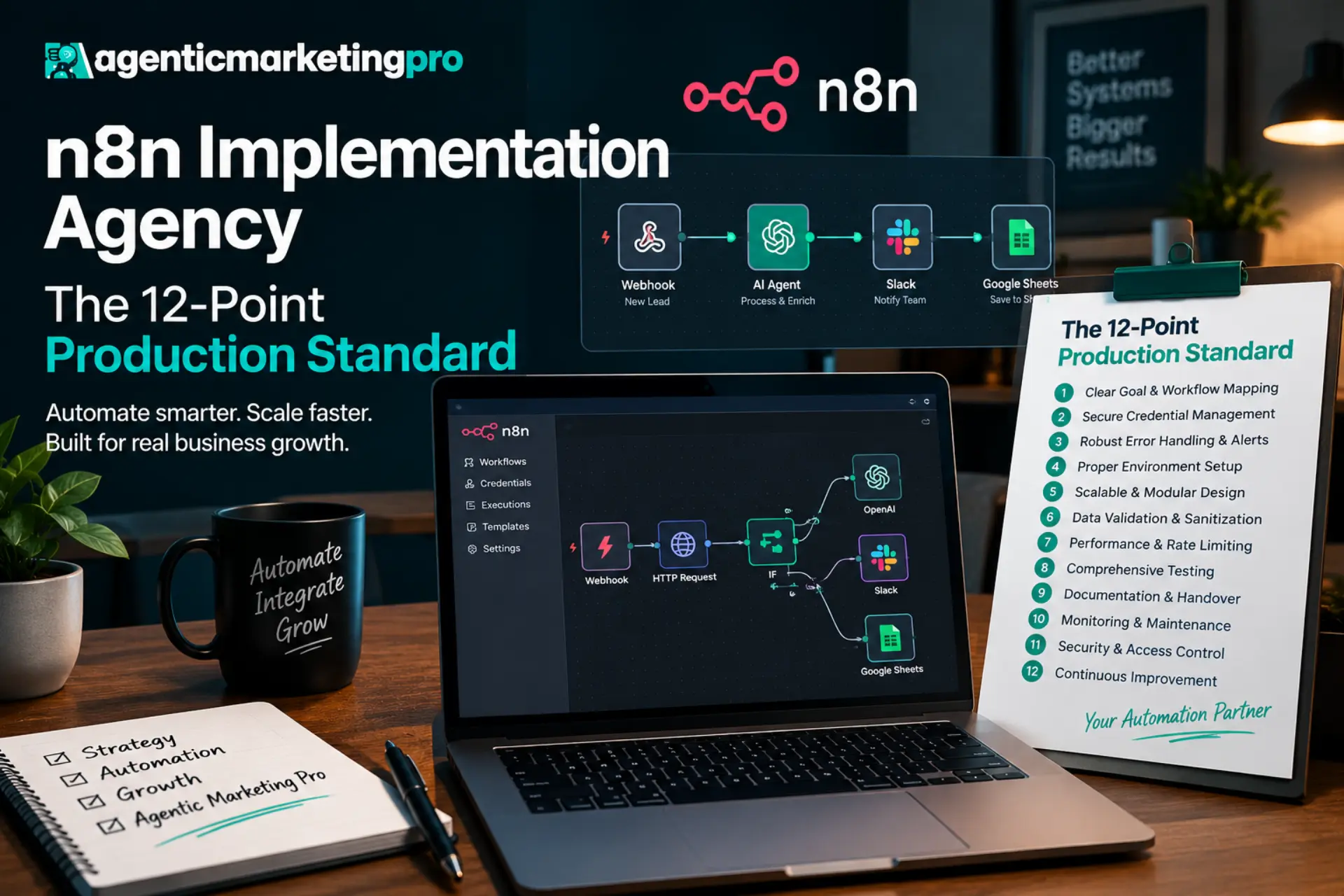
The 12-Point Production-Readiness Standard
Every production-ready n8n deployment passes twelve checks: four on error handling, three on monitoring, three on versioning, and two on service levels — and each check produces an artifact you can inspect before signing. This is the standard we build against and publish; use it as your audit sheet.
| # | Check | What to demand | Pillar |
|---|---|---|---|
| 1 | Error workflows attached | Every production workflow has a linked error workflow routing failures to a handler | Error handling |
| 2 | Retry policies configured | Retries with backoff on flaky nodes — set in node settings, not hopes | Error handling |
| 3 | Idempotent writes | Retries cannot create duplicate customers, orders, or tickets — stable IDs everywhere | Error handling |
| 4 | Dead-letter routing | Unprocessable items land in a review queue, never silently dropped | Error handling |
| 5 | Execution logging on | Full execution history retained per your policy; logs inspectable per run | Monitoring |
| 6 | Proactive alerting | Failures ping Slack/email/PagerDuty within minutes — not discovered at month-end | Monitoring |
| 7 | Health dashboards | Success rate, volume, duration, and cost visible per workflow | Monitoring |
| 8 | Git-backed source control | Workflow JSON in version control with meaningful commits | Versioning |
| 9 | Staging → production pipeline | Changes tested in a staging instance before touching production | Versioning |
| 10 | Change review trail | Every production change reviewable: who, when, what, why, rollback path | Versioning |
| 11 | SLA with response times | Named severity tiers with response and resolution targets — in the contract | Service levels |
| 12 | Documentation & handover | Runbook per workflow; your team could operate it without the agency | Service levels |
Score it like the audits in our comparison framework: 11–12 with artifacts = production partner; 7–10 = strong builder, negotiate the gaps; below 7 = the workflows will be yours to babysit. The next three sections explain the why behind each pillar’s checks, with our public deep dives linked throughout — we publish our reliability engineering precisely so buyers can audit the standard.
The n8n Ecosystem in 2026: The Data Behind the Standard
n8n’s 2026 numbers — 1.7 million monthly active builders, 1,400+ enterprise customers, a $5.2B valuation after SAP’s strategic stake — explain why “production-ready” became a hiring criterion rather than a nicety. When the platform runs inside SAP’s Joule Studio, the freelance-grade workflow your business depends on is no longer good enough.
| Metric | 2026 value | Why it matters to buyers |
|---|---|---|
| Valuation | $5.2B (doubled; SAP strategic stake) | Platform longevity risk drops — safe to standardize on |
| Total raised | ~$254M across 4 rounds | Enterprise roadmap is funded, not aspirational |
| Monthly active builders | 1.7M | Talent pool exists; specialists are findable |
| Enterprise customers | 1,400+ | The production patterns are proven at scale |
| Integrations | 2,300+ nodes (n8n.io/integrations) | Connector coverage is table stakes; design is the differentiator |
Sources: valuation and SAP stake per AYAutomate’s 2026 enterprise analysis and RevenueMemo’s funding history; usage figures per the 2026 n8n statistics report traced to first-party sources; platform facts from n8n.io’s own pages. The buyer takeaway is not “n8n is popular” — it is that with 1,400+ enterprises on the platform, the failure patterns are known, documented, and preventable, which is precisely what the twelve checks do.
Error Handling: What an n8n Implementation Agency Actually Ships
Production error handling in n8n means four mechanisms working together — linked error workflows, configured retries, idempotent writes, and dead-letter routing — and every one of them is inspectable in the workflow JSON before you sign. Happy paths are easy; these four are the engineering.
We publish our full engineering notes on each mechanism. The failure catalog — the twelve most common production breakages and their fixes — is in n8n production error patterns; retry design with backoff math in n8n retry logic; the triage methodology in n8n debugging; and credential hygiene — the error-handling topic buyers most often skip — in n8n secrets management. An n8n implementation agency that can’t discuss these four documents fluently is learning on your budget.
n8n Implementation Agency Monitoring & Observability: Checks 5–7
Production monitoring in n8n means execution data retained deliberately, alerts that find you before you find them, and dashboards that answer “is the business process healthy?” without opening the editor. n8n ships the primitives — execution logs, error triggers, webhook monitoring — and the n8n implementation agency’s job is to assemble them into observability.
Three questions test an agency’s monitoring maturity in five minutes. What’s your alert-to-detection time on a failed execution? (Production answer: minutes, via error workflow → notification node; anything involving “we check the dashboard weekly” is a no.) How long is execution data retained, and who can see it? (There should be a stated policy — retention costs storage; n8n’s own execution-data settings are the knob.) Where do I see cost per workflow? (Mature agencies track token/API spend per workflow, because runaway LLM spend is a documented agentic failure mode.) Our operational patterns for scaling these answers — queue mode, workers, database tuning — are public in n8n enterprise scaling, and the analytics layer in n8n success KPIs.
The observability floor for a business-critical workflow: success rate and volume visible per day, failure alerts within five minutes, and a monthly health report your operations lead can read without translation. That floor is checks 5–7 of the standard, and it is non-negotiable for anything touching customers or money.
Versioning, Environments & SLAs: Checks 8–12
Versioning means workflow JSON lives in git, changes flow staging → production through review, and every production change has a rollback path — while the n8n implementation agency’s SLA puts a clock on incident response and the handover docs make the system yours. These five checks are where “agency quality” becomes contract quality.
Our documented practice for the versioning pillar: git integration patterns for workflow source control, and sub-workflow architecture — the design choice that keeps workflows testable and promotable instead of monolithic. For self-hosted production infrastructure, Kubernetes deployment covers the environment layer. On the SLA itself: demand severity tiers (SEV1 response ≤ 1 hour, SEV2 ≤ 1 business day is a reasonable 2026 standard for business-critical workflows), a named on-call path, and the kill-switch confirmation we covered in the 25-question kit. Documentation — check 12 — is the quiet one: a runbook per workflow, architecture notes, and admin credentials in your vault. If the agency hesitates on handover docs, re-read pillar 5 of the development-company due-diligence guide.
Cloud vs Self-Hosted: The n8n Implementation Agency Decision
A real n8n implementation agency walks you through the hosting decision — n8n Cloud for zero-ops speed, self-hosted for data control and cost at scale — instead of the n8n implementation agency defaulting to whichever it prefers administrating. The honest answer depends on data sensitivity, volume, and whether anyone on your side wants to own infrastructure.
| Factor | n8n Cloud | Self-hosted |
|---|---|---|
| Time to first workflow | Hours — nothing to run | Days — infrastructure first |
| Data residency control | Limited to plan options | Complete — your servers, your region |
| Cost at high volume | Execution-based pricing scales up | Flat infra cost; compute is yours |
| Ops burden | None (n8n runs it) | Upgrades, backups, monitoring on you/agency |
| Custom nodes & code | Supported within plan limits | Unrestricted |
The full decision matrix — including the €20–€50/month Cloud tiers versus realistic self-hosting costs — is our n8n Cloud vs self-hosted comparison, with infrastructure math in n8n self-hosting costs and hardening in webhook security. The pattern we recommend for most SMBs: start on Cloud, migrate to self-hosted when monthly execution volume makes the economics flip — and make that trigger a written line in the engagement, not a future surprise invoice.
How to Vet an n8n Implementation Agency: 3 n8n-Specific Probes
Vet an n8n implementation agency with three n8n-specific probes on top of the general framework: review an error-workflow JSON, read their execution-history policy, and ask them to refactor a deliberately fragile workflow. General agency questions catch general problems; these three catch the n8n ones.
- The artifact probe. “Show me an error workflow from a live deployment — the actual JSON.” You are checking for: error trigger node, meaningful routing (not just an email), retry context, and alert integration. Production shops produce this instantly.
- The policy probe. “What is your execution-data retention default, and why?” Good answers reference storage costs, debugging windows, and GDPR-style constraints — a considered trade-off, not a shrug.
- The refactor probe. Hand them a fragile workflow (or describe one: no error handling, duplicate creates on retry, secrets in plain nodes) and ask what they’d change. Listen for the twelve checks by name — error workflow, idempotency keys, staging promotion, credential hygiene.
Score with the 10-area framework as the chassis, the twelve-point standard as the n8n overlay, and the 25 questions for the interview itself. Budget a paid pilot — ours run $1,500–$4,000 with a workflow delivered to the twelve-check standard and acceptance tests written before the build — which is simultaneously the fourth probe: the only one conducted on your infrastructure instead of their slideware.
Costs, Engagement Models & Our Own Practice
n8n implementation agency pricing in 2026 runs $300–$1,000 for simple workflow builds, $1,000–$3,000 for medium projects, $3,000–$8,000 for complex AI-agent workflows, and $5,000–$15,000 for multi-workflow systems, with management retainers at $100–$1,000+ per month — the same bands we publish and source in the AI automation agency cost guide. The production-readiness premium is real and worth it: the delta between a build-only quote and a twelve-check build is typically 30–50%, and it buys the difference between an automation and a liability.
For the value side of that arithmetic, the n8n hours-saved calculator models payback from your own task volumes, and our practice pages show what the standard looks like in delivery: the n8n AI agent development service (the engineering behind these workflows) and the agency qualification guide for teams adopting n8n internally. Every claim on this page — the standard, the checks, the practice — exists to be audited. That is what production-ready means.
How do your n8n workflows score on the 12 checks?
The free audit reviews your existing n8n workflows against the production-readiness standard — error handling, monitoring, versioning, SLAs — and lists what’s missing, with fixes priced.
TS Nion — Senior Digital Marketer & Automation Expert, AgenticMarketingPro
TS builds n8n systems to the twelve-check standard and maintains the reliability documentation linked throughout this guide. Ecosystem figures verified October 2026 against first-party-sourced statistics; re-checked quarterly. Full background →
Production-ready n8n workflows are not a feature you order — they are a standard you audit: error workflows attached, retries configured, idempotency designed, monitoring live, versions in git, SLAs in the contract, docs in your hands. Twelve checks, four pillars, three probes, one paid pilot. The agencies that pass build systems that run while you sleep; the ones that don’t build workflows that page you at 2 a.m.
Want your workflows measured against the standard? Contact us today — the audit is free and the twelve-point scorecard is yours either way.
n8n Implementation Agencies: FAQ
Which agencies build production-ready n8n workflows for businesses?
Specialist n8n consultancies, automation agencies with dedicated n8n practices, and enterprise integration shops. The production tell: error workflows, retry policies, monitoring with alerting, git versioning, and SLAs appear in their standard scope — verify with the 12-point readiness standard (4 error-handling, 3 monitoring, 3 versioning, 2 service-level checks), one artifact per check.
What makes an n8n workflow production-ready?
A production-ready n8n workflow fails safely, observably, and reversibly: an error workflow catches failures, retries with backoff handle flaky nodes, writes are idempotent so retries can’t duplicate records, unprocessable items reach a dead-letter queue, executions are logged and alerted, the JSON is git-versioned through staging, and an SLA plus runbook cover operations.
How much does an n8n implementation agency charge?
2026 rates: $300–$1,000 for simple workflow builds (2–5 integrations), $1,000–$3,000 for medium projects with APIs and error handling, $3,000–$8,000 for complex AI-agent workflows, and $5,000–$15,000 for multi-workflow systems. Management retainers run $100–$1,000+ monthly. Production-readiness (the full 12-check standard) typically adds 30–50% over build-only quotes.
Is n8n enterprise-ready in 2026?
Yes — n8n reached a $5.2 billion valuation in 2026 with SAP taking a strategic stake and embedding n8n in Joule Studio, serving 1,400+ enterprise customers and 1.7 million monthly active builders on roughly $254M raised. Enterprise readiness of the platform, however, is separate from production readiness of your workflows — which is what the 12-check standard audits.
What is an n8n error workflow?
An error workflow is n8n’s dedicated mechanism for handling failed executions: an Error Trigger node fires when a linked workflow fails, routing the failure context (which node, what error, which items) to a handler that alerts, logs, and triages. Production deployments attach one to every business-critical workflow — asking to see one is the fastest agency litmus test.
Should we use n8n Cloud or self-host?
n8n Cloud (from about €20–€50/month) wins on speed and zero ops — hours to first workflow, no infrastructure. Self-hosting wins on data residency, unrestricted custom code, and flat costs at high execution volume, at the price of running upgrades, backups, and monitoring yourself. Most SMBs should start on Cloud and migrate when monthly volume flips the economics — a trigger worth writing into the engagement.
How do I verify an agency’s n8n skills before hiring?
Three n8n-specific probes: ask for an error-workflow JSON from a live deployment (production shops produce it in under a minute); ask their execution-data retention policy and why (a considered trade-off, not a shrug); and hand them a deliberately fragile workflow to refactor, listening for the twelve checks by name. Finish with a paid pilot delivered to the 12-check standard.
Can n8n connect my CRM, ERP, marketing, and support tools?
Yes — n8n advertises 2,300+ integrations plus custom HTTP/API calls, webhooks, and JavaScript/Python for anything without a native connector. The real risks are architectural, not connector coverage: systems of record should stay authoritative (n8n orchestrates, doesn’t own data), writes must be idempotent, and workflows need the error-handling and versioning standard — which is exactly the implementation agency’s job.
Leave a Reply