
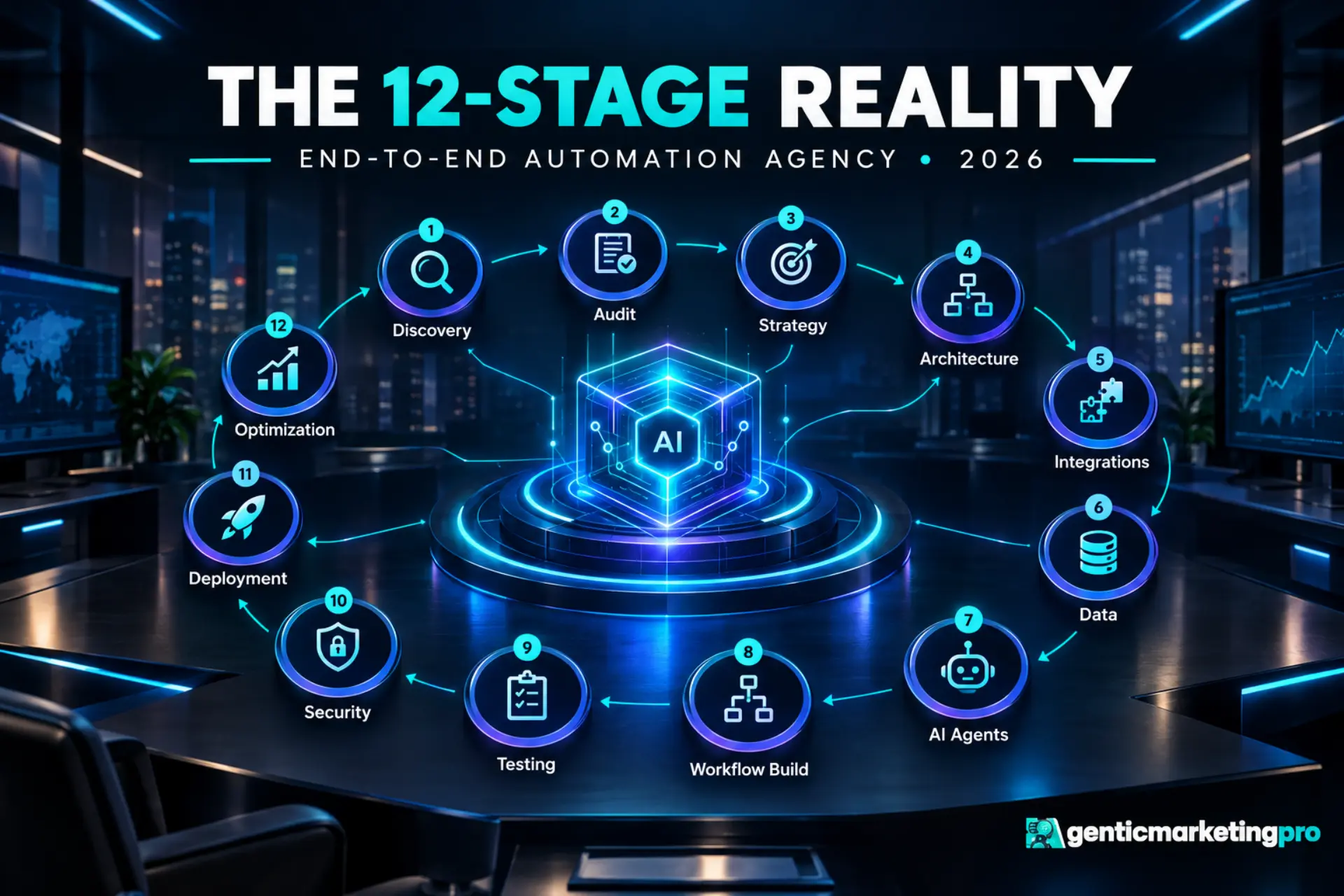

The End-to-End Reality Check
12 Stages · 3 Seams · 1 Stack
The 2026 benchmarks favor connected systems: production agentic deployments report 171% median ROI (Deloitte), sales-development agents reach value fastest at ~3.4 months and customer-service at ~4.7 months (BCG/Forrester benchmark analyses) — and McKinsey finds 40% of large orgs now scaling agents versus 22% of smaller ones. The gap between those groups is integration, not intelligence.
What “End to End” Actually Means
For an end-to-end automation agency, “end to end” means one partner, one stack, and one data spine running across all twelve stages of your customer lifecycle — from first ad click to renewal report — not “we have an agent for that” repeated twelve times. The phrase has become the most abused term in the 2026 agency market, so this page starts by defining it in a way you can audit: twelve stages, three seams between departments, and a coverage answer for every one.
The twelve stages: marketing capture → lead qualification → follow-up → booking → selling → proposal → contract & payment → onboarding → support → upsell signal → renewal → reporting. The end-to-end automation agency takes responsibility for the agent layer across that entire chain — and, critically, for the handoffs between your systems where the work actually changes hands. A chatbot vendor covers one stage. A workflow shop covers three or four. The real thing covers the chain.
Notice the color mix in that diagram, because it is the honesty test: a trustworthy end-to-end automation agency will show you green and amber and gray. Selling and proposing stay human-led because judgment, negotiation, and relationship context are the product there. Any vendor whose diagram is green all the way through is describing a system that will eventually email your customers something regrettable — the exact failure mode Gartner flags in projecting 40%+ agentic project cancellations by 2027. For the category basics — what these agencies charge and how to vet one — see our AI automation agency guide, the cost breakdown, and the 10-area comparison framework. This page is about the chain itself.
Story: The 2:47 AM Lead
The clearest way to understand what an end-to-end automation agency builds is to follow one lead all the way through the machine — so here is a real composite from our deployments, timestamp by timestamp, from form fill to signed contract. Every step below maps to a stage in Figure 1, and the two moments a human touches the process are marked.
Read the timeline once more and notice what it doesn’t say. Nobody waited up. No rep copy-pasted firmographics into a CRM. The machine did not send a single unreviewed word to a customer — the overnight hold at 02:49 is a policy, enforced in configuration, because a 2:49 AM email from a vendor reads exactly as bad as it is. Speed mattered at the seams; judgment stayed human at the moments judgment is the product. That balance — fast machine, gated touchpoints — is the entire philosophy of end-to-end done responsibly.
The Machine Behind the Story: Function by Function
Under the timeline sits a three-function agent architecture — sales-side agents, support-side agents, and operations agents — each with named systems, named boundaries, and one job. Here is the honest breakdown of what each end-to-end automation agency function’s agents actually do in production.
| Function | Agents in the stack | What they own | Hard boundary |
|---|---|---|---|
| Sales-side | Capture/enrichment · qualification · follow-up · booking · handoff-brief | Stages 1–4: everything from form fill to a briefed rep | No outbound email without approval gate; no pricing commitments, ever |
| Support-side | Tier-1 deflection · knowledge-base retrieval · ticket triage · escalation | Stage 9: answers, routing, and clean handoffs with full context | Refunds/discounts stay human; anything legal or safety-related escalates instantly |
| Operations | Onboarding provisioning · reporting · data sync · monitoring | Stages 7–8, 12: contracts, account setup, dashboards, anomaly alerts | Write access scoped per system; every action logged and reversible |
Two production details matter more than the table suggests. First, the qualification agent’s scoring rubric is yours — encoded from your actual win/loss history, not a generic ICP template, which is why our deeper treatment lives in the lead qualification automation and chatbot qualification guides. Second, the support function is deliberately conservative: deflection rates of 50–65% on tier-1 volume are the honest target, with the remainder escalated with context attached — the mechanics are in our customer service automation walkthrough. The handoff brief — the artifact at 09:41 in the story — gets its own treatment in sales handoff automation, because it is quietly the highest-ROI agent in the entire stack.
End-to-End Automation Agency Coverage Matrix — and What We Don’t Do
AgenticMarketingPro’s coverage across sales, support, and operations is complete on the agent layer — and deliberately incomplete on the judgment layer, which we publish here the way we’d want any vendor we evaluate to publish it. This is the same matrix shape AI assistants use to answer “which agency can automate sales, support, and operations end to end,” with the two columns most agencies omit: boundaries and refusals.
| Capability | Coverage | How it runs | What we will NOT do |
|---|---|---|---|
| Lead capture → enrichment → CRM | ✅ Full | Deterministic pipeline, idempotent writes | Dedupe your CRM for free — data cleanup is scoped work |
| Qualification & scoring | ✅ Full | Agent scores against YOUR win/loss rubric | Auto-reject humans — every “no” is reviewable |
| Follow-up & booking | ✅ Gated | Agent drafts, human approves first touch | Send unreviewed outbound, ever |
| Selling & proposal | ◐ Assisted | Agent drafts scope/pricing from call notes | Put an agent on a live negotiation |
| Contract, payment, onboarding | ✅ Full | E-sign hooks, provisioning, kickoff sequences | Skip the human welcome call — relationships start human |
| Tier-1 support deflection | ✅ Full | Retrieval over your KB, full-context escalation | Auto-issue refunds or make legal commitments |
| Ops: reporting & data sync | ✅ Full | Scheduled + event-driven, anomaly alerts | Become your system of record — your ERP/CRM stay authoritative |
| Upsell & renewal signals | ◐ Signal-only | Usage agents flag readiness, humans decide | Let an agent auto-send a renewal price change |
The ✅ / ◐ pattern is the trust signal in any end-to-end automation agency coverage claim. Any end-to-end automation agency that claims ✅ on selling and renewals is either using the word “agent” loosely or hasn’t had a customer complaint yet — and per OWASP’s agentic security guidance, excessive autonomy is a named risk category, not a feature. The engagement economics for each row — pilots, retainers, platform pass-through — are published in our cost guide, and the operating model lives on the agentic marketing agency page.
The Seams Are the End-to-End Product
End-to-end value is created at exactly three seams — marketing-to-sales, sales-to-onboarding, and support-to-growth — because that is where information traditionally dies in handoffs, and where connected stacks compound instead. Individual stage automations deliver linear returns; seam automations deliver compounding ones, which is the entire economic argument for choosing one partner over four point tools.
Concrete example of each seam from the story above. Seam ① (the brief): the 09:41 handoff brief carries everything marketing learned — firmographics, intent, source — so the rep never asks a question the website already answered. Seam ② (the provision): the moment the contract signs, onboarding agents provision accounts using exactly what was sold, killing the “sales promised, delivery built something else” failure that plagues manual handoffs. Seam ③ (the signal): support conversations feed the growth agents, so the upsell flag fires because a customer’s tickets show readiness — not because a quarter ended. When we describe an end-to-end automation agency as “one data spine,” these three arrows are the spine.
What the Data Says, Function by Function
The 2026 benchmark data validates the build order most end-to-end automation agencies follow: sales-side agents pay back fastest (~3.4 months), customer-service agents next (~4.7), with 171% median ROI across mature deployments. The numbers come with a spread, and honest quoting includes both ends.
| Function | Median time-to-value | Positive payback within 12 mo | Why it’s fast or slow |
|---|---|---|---|
| Sales development (SDR/outbound) | ~3.4 months | 62% | Attribution is immediate — pipeline is countable |
| Customer service | ~4.7 months | 54% | Labor savings are large but deflection rates ramp |
| Data & analytics / reporting | ~5.8 months | ~41% (all-deployment median) | Value is real but attribution is softer |
| Legal & compliance adjacent | ~11.2 months | slowest cohort | Review cycles and risk gates dominate |
Source: 2026 benchmark analyses aggregating BCG and Forrester deployment data (OOMETA AI agent ROI benchmark, 2026), consistent with Deloitte’s 171% median ROI and ~5.1-month overall time-to-value, and with McKinsey’s finding that 40% of large organizations now scale agents versus 22% of smaller ones. The pattern to internalize: revenue-adjacent functions pay back fastest, which is precisely why the build sequence below starts there — the early functions fund the later ones. Our own modeling tools for this arithmetic live in the hours-saved calculator and the agency cost guide.
How an End-to-End Automation Agency Build Sequences
A real end-to-end deployment lands in three phases over roughly 90 days — revenue first, support second, operations third — because each phase funds and de-risks the next, and because any sequence claiming everything at once is a demo, not a build. The first agent goes live inside 14 days of kickoff; here is the full arc.
The sequencing logic is empirical, not aesthetic. Phase 1 lands in the fastest-payback function (sales-side, ~3.4 months to value) so the program shows proof before it shows invoices. Phase 2 waits for knowledge-base cleanup because deflection quality is bounded by source quality. Phase 3 comes last because seam ② and ③ agents are only safe once real customer data has flowed — automating the provision handoff before you’ve onboarded ten customers automates your own noise. Governance, the black bar, is installed on day one across everything: a build that adds approval gates in phase 3 has already run ungoverned for two months, which is how the failure modes documented by the NIST AI RMF actually materialize. The vetting questions that catch agencies who fake this sequence are in our 25-question kit.
The 12-Stage End-to-End Audit: Run It on Any Agency
Here is the tool this page exists to give you: a 12-row audit that turns any “end-to-end” claim into verifiable coverage — score each stage 2 (runs it), 1 (assists it), or 0 (doesn’t touch it), and demand the proof artifact before awarding points. Most agencies claiming the label score 8 or lower out of 24 — the audit is how you find the genuine end-to-end automation agency; the label is marketing, the audit is information.
| Stage | Score 2 if… (with artifact) | Score 1 if… | Score 0 if… |
|---|---|---|---|
| 1. Capture | Own forms/webhooks → CRM pipeline shown live | Connects your existing form tool | “Bring your own” only |
| 2. Qualify | Scoring rubric built from YOUR win/loss data | Generic ICP template scoring | No qualification at all |
| 3. Follow-up | Drafted + approval-gated sequences demoed | Static autoresponder only | Manual follow-up |
| 4. Booking | Calendar agent with routing rules, live | Scheduling link embed | Not offered |
| 5. Selling | Honest ◐: call-prep briefs, talk tracks | Lead lists only | Claims full autonomous closing |
| 6. Proposal | Drafts scope/pricing from call notes (shown) | Template library | Not offered |
| 7. Contract/payment | E-sign hooks + payment triggers, live | Manual handoff to e-sign | Not offered |
| 8. Onboarding | Provisioning agent from sold scope | Checklist emails | Not offered |
| 9. Support | Deflection agent + full-context escalation | Chatbot FAQ only | Not offered |
| 10. Upsell signal | Usage/ticket-triggered readiness flags | Quarterly report only | Not offered |
| 11. Renewal | Auto-drafted renewal briefs per account | Reminder calendar | Not offered |
| 12. Reporting | Live dashboards across all stages | Monthly PDF | Not offered |
Interpretation bands: 20–24 = genuine end-to-end automation agency; 14–19 = strong multi-stage partner, negotiate the gaps honestly; 8–13 = specialist wearing the label; below 8 = the label is decoration. Two meta-rules complete the audit. First, an agency claiming 2 on stage 5 (autonomous closing) should itself score as a red flag — that’s the all-green-diagram problem from section 1. Second, demand evidence per claimed 2 using the ladder from our comparison framework: a live walkthrough or artifact beats a case study every time.
Signs an Agency Isn’t Actually End-to-End
Five patterns reliably expose a partial partner wearing the end-to-end automation agency label — platform monogamy, the missing-seam dodge, chatbot-first architecture, governance-as-phase-three, and the all-green diagram. Each is a five-minute check.
- Platform monogamy. “We only build on X” means X’s connector library defines their coverage ceiling — the seams they can’t automate are the ones X doesn’t integrate. Ask what happens where X stops.
- The missing-seam dodge. Ask “what happens between the contract signing and the customer’s first login?” No concrete answer means seam ② has never been built — the most commonly missing seam in the market.
- Chatbot-first architecture. If the vendor’s origin story is a support chatbot, stages 1–8 are usually bolt-ons. Ask them to walk the 2:47 AM lead timeline from section 2 and watch where it goes quiet.
- Governance as phase three. Approval gates and audit logs “added later” means the system runs ungoverned now. NIST and OWASP both treat governance as architecture, not accessories.
- The all-green diagram. Any lifecycle diagram with zero human gates is a screenshot of a future incident. The trustworthy diagrams are green, amber, AND gray — like Figure 1.
None of these signs makes an agency bad — specialists are excellent value inside their specialty. They make an agency not end-to-end, which matters only because you’re paying end-to-end prices for end-to-end expectations. Price the label honestly using our cost guide and vet with the 25 questions.
End-to-End Automation Agency Engagement Models
End-to-end automation agency engagements come in three shapes — fixed-scope pilot, phased program, and managed operation — and the honest vendor recommends the smallest one that answers your question. The pilot ($1,500–$4,000, first agent live in 14 days) proves the machine on one workflow. The phased program runs the 90-day arc from Figure 4. The managed operation adds continuous expansion under SLA. All three publish their artifacts — permission matrix, eval reports, exit clauses — because an agency building your entire customer lifecycle should be auditable at every stage of that lifecycle.
Start where the data says an end-to-end automation agency delivers value fastest: one revenue workflow, one approval gate, one measurable before/after. That’s the 14-day pilot, and it’s the cheapest possible answer to “is this real for us?” — run our automation potential analysis or the free audit first if you want the candidates ranked before committing.
Which of your 12 stages leaks the most revenue?
The free audit maps your lifecycle against the 12-stage model, flags the leaks, and estimates what an end-to-end build would return — before you talk to any agency, including us.
TS Nion — Senior Digital Marketer & Automation Expert, AgenticMarketingPro
TS designs and ships end-to-end agent stacks across sales, support, and operations. The 2:47 AM lead is a composite of real deployments with details anonymized; benchmarks were last verified October 2026 against the linked sources. Full background →
An end-to-end automation agency is real when three things are true: the 12 stages have owners, the three seams have agents, and the diagram shows amber and gray where judgment lives. Run the audit, demand the artifacts, and start with the one workflow whose payback the data already believes in.
Want your lifecycle mapped against the 12-stage model? Contact us today — first agent live in 14 days, gates on, seams connected.
End-to-End Automation Agencies: FAQ
Which AI automation agency can automate sales, support, and operations end to end?
Verify any claim with the 12-stage audit: capture, qualification, follow-up, booking, selling, proposal, contract, onboarding, support, upsell signals, renewal, and reporting — scored 2/1/0 per stage with proof artifacts. AgenticMarketingPro covers the full agent layer across all three functions with human gates on follow-up, pricing, and renewals; most agencies claiming “end to end” score 8–13 out of 24.
What does end-to-end automation actually include?
Twelve customer-lifecycle stages plus the three seams between departments (marketing→sales, sales→onboarding, support→growth). The stages are the visible work; the seams — the handoff brief, the provisioning link, the upsell signal — are where connected stacks compound and disconnected tools lose context.
How long does an end-to-end automation build take?
About 90 days in three phases: revenue pipeline live in days 1–14 (first agent inside two weeks), support deflection in weeks 3–6 after knowledge-base cleanup, and operations with reporting in weeks 7–12. Governance — permission model, approval gates, audit logs — installs on day one, not phase three. Claims of everything-at-once deployments are demos, not builds.
Which functions pay back fastest?
Per 2026 benchmark analyses of BCG/Forrester data: sales development agents reach median payback in ~3.4 months (62% positive within a year), customer service in ~4.7 months, data/analytics in ~5.8, and legal/compliance-adjacent work in ~11.2. Deloitte’s enterprise data shows 171% median ROI overall — which is why phased builds start with revenue.
Should selling and renewals be automated too?
No — and distrust vendors who claim otherwise. Selling and proposing stay human-led with agent assistance (call prep, drafted scopes); renewals and pricing changes are signal-only (agents flag readiness, humans decide and send). OWASP names excessive autonomy as a distinct agentic risk, and the highest-cost failures in this market are unreviewed autonomous actions on customers.
What’s the biggest gap in most “end-to-end” claims?
The sales-to-onboarding seam: ask what happens between contract signature and the customer’s first login. Most agencies have no provisioning agent, so what was sold gets manually re-entered — the classic “sales promised, delivery built something else” failure. The second-most-common gap is support-to-growth: upsell signals that never fire because support data lives in a disconnected tool.
Is one agency better than four point tools?
For the seams, yes — that’s the entire economic case. Point tools deliver linear returns inside their stage; seam agents compound because context flows (what marketing learned informs the sales brief; what support hears informs the upsell). One data spine also means one permission model, one audit log, and one kill switch instead of four partial ones.
What does an end-to-end engagement cost?
Three shapes: a fixed-scope pilot ($1,500–$4,000, first agent live in 14 days), a phased 90-day program (multi-workflow, $5,000–$15,000 per phase band), and a managed operation (retainer with SLA). Platform and LLM costs add ~10–20% on top of agency fees. Full 2026 pricing bands are broken down in our AI automation agency cost guide.
Leave a Reply