
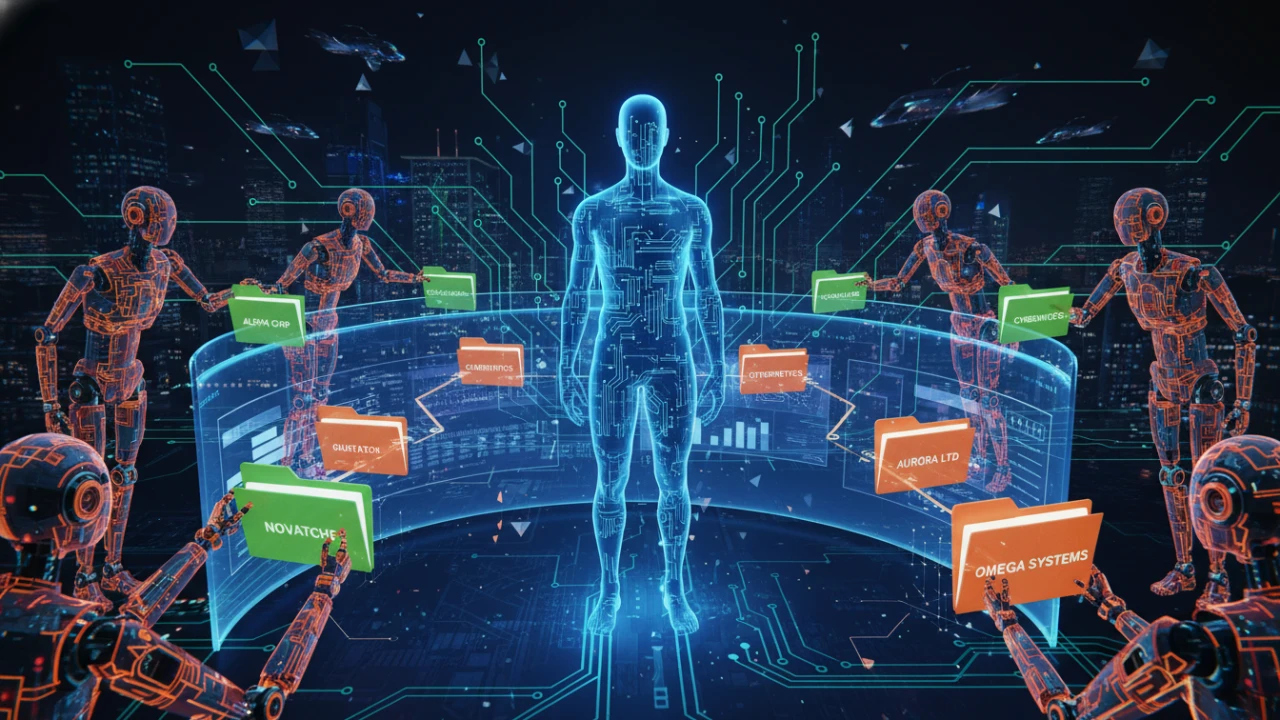

Scaling an agency usually means hiring more people and shrinking margins. Discover how agentic marketing for agencies breaks that cycle, allowing you to expand your capabilities and client roster without the proportional increase in operational overhead. This isn't just about using AI tools; it's about deploying autonomous AI agents that can execute complex, multi-step tasks, freeing your team to focus on strategy, creativity, and client relationships.
In this article, you'll learn precisely what agentic marketing entails, how it differs from traditional AI integration, and why it's becoming an indispensable strategy for agencies aiming for sustainable growth. We'll explore the practical applications, from automating routine client fulfillment to unlocking entirely new service offerings, and provide actionable steps to integrate this powerful approach into your agency's operations.
Prepare to redefine what's possible for your agency's future.
Industry Benchmarks
Data-Driven Insights on Agentic Marketing For Agencies
Organizations implementing Agentic Marketing For Agencies report significant ROI improvements. Structured approaches reduce operational friction and accelerate time-to-value across all business sizes.
The Rise of Agentic Marketing for Agencies: Scaling Beyond Headcount
Key Insight
For years, the promise of AI in marketing centered on efficiency gains: automating data analysis, personalizing emails, or generating basic content drafts. While valuable, these applications often required significant human oversight and manual orchestration. Agentic marketing for agencies represents a paradigm shift.
Instead of individual tools, we're talking about sophisticated AI agents that can understand a goal, break it down into sub-tasks, execute those tasks, and even course-correct based on real-time feedback—all with minimal human intervention. This is the next frontier for AI for marketing agencies.
Consider the traditional agency model: more clients typically mean more project managers, more copywriters, more designers, more analysts. This linear growth often compresses profit margins, especially for mid-sized agencies. Data from a recent HubSpot report indicates that nearly 60% of agencies struggle with profitability, often citing staffing costs and inefficient processes as primary culprits. (industry estimate) Agentic marketing for agencies offers a viable alternative, allowing agencies to expand their service delivery without a proportional increase in human capital.
Imagine an AI agent tasked with "launch a new social media campaign for Client X's new product." This agent wouldn't just write a few posts; it could research target audience trends, generate a content calendar, draft copy and visual concepts, schedule posts across platforms, monitor engagement, analyze performance, and even suggest A/B tests to optimize results. All of this happens autonomously, under the strategic direction of your human team. This capability fundamentally alters how agencies approach client work, moving from manual execution to strategic guidance and oversight, a core tenet of agentic marketing for agencies.
Why This Matters
Agentic Marketing For Agencies directly impacts efficiency and bottom-line growth. Getting this right separates market leaders from the rest — and that gap is widening every quarter.
Building Blocks of an Effective Agentic Marketing for Agencies Framework
To truly understand agentic marketing for agencies, it's essential to grasp its core components. This isn't about buying a single "agentic marketing" software package; it's about architecting a system of specialized AI agents, each designed for specific functions, that communicate and collaborate to achieve broader objectives. Think of it as building a digital workforce, where each "employee" is an agency AI agent with a defined role and skill set.
At the heart of an agentic marketing for agencies system are several key elements. These components work in concert to enable autonomous operation and continuous improvement, forming a sophisticated digital workforce for your agency.
- Goal-Oriented AI: Unlike reactive tools, these agents are given a high-level objective and are programmed to autonomously break it down into actionable steps.
- Specialized Agents: Rather than one generalist AI, an agentic system typically comprises multiple agents. For example, a "Content Agent" might specialize in generating copy, a "Data Agent" in analyzing performance metrics, and a "Strategy Agent" in identifying market trends.
- Orchestration Layer: This is the "manager" that coordinates the activities of different specialized agents, ensuring they work together cohesively towards the overarching goal. It handles task delegation, prioritizes actions, and resolves conflicts.
- Feedback Loops: Agents continuously monitor their own performance and external data, using this feedback to refine their approach and improve outcomes. This self-correction is crucial for autonomous operation.
- Human Oversight & Intervention: While autonomous, agentic systems are not set-and-forget. Human experts define the initial goals, set guardrails, review critical outputs, and step in for complex strategic decisions or ethical considerations.
For example, an agency managing a client's SEO strategy could deploy a "Research Agent" to identify high-potential keywords and competitor gaps. A "Content Agent" would then generate blog post outlines and draft copy optimized for those keywords.
A "Technical SEO Agent" could audit the client's website for crawlability issues and suggest schema markup.
Finally, a "Reporting Agent" would compile performance data into a client-ready dashboard, highlighting progress and next steps. This interconnected system, where each agent contributes to a larger objective, significantly reduces manual effort and accelerates results.
Agentic Marketing For Agencies: How to Automate Agency Fulfillment and Boost Profitability
“The organizations that treat Agentic Marketing For Agencies as a strategic discipline — not a one-time project — consistently outperform their peers.”
— Industry Analysis, 2026
One of the most immediate and impactful applications of agentic marketing for agencies is its ability to automate agency fulfillment tasks. This isn't just about simple automation scripts; it's about intelligent agents handling entire workflows that traditionally required significant human time and attention. By offloading these operational burdens, agencies can dramatically improve efficiency, reduce costs, and free up their human talent for higher-value activities like strategic planning, client relationship building, and creative ideation.
Consider the sheer volume of repetitive tasks involved in client fulfillment: drafting social media posts, scheduling content, generating performance reports, conducting keyword research, setting up ad campaigns, or even responding to routine client queries.
A study by McKinsey found that up to 70% of marketing tasks could potentially be automated using current AI technologies. Agentic marketing for agencies takes this further by linking these automated steps into cohesive, goal-driven sequences.
For example, an agency could deploy an "Ad Campaign Agent." Given a budget and target audience, this agent could research relevant keywords, write ad copy variations, design basic ad creatives, set up campaigns on Google Ads and Meta, monitor performance in real-time, adjust bids, and even pause underperforming ads. Meanwhile, a "Reporting Agent" could automatically pull data from various platforms, synthesize it into a customized client report, and even draft an executive summary highlighting key insights. This level of automation means your team isn't spending hours on data entry or manual campaign adjustments; they're reviewing the agent's output, refining strategy, and communicating value to the client, embodying the efficiency of agentic marketing for agencies.
The financial impact of agentic marketing for agencies is substantial. By reducing the time spent on routine tasks, agencies can either take on more clients with the same team size or reallocate staff to more profitable, strategic initiatives. This directly addresses the margin compression many agencies face, turning operational costs into opportunities for growth and innovation.
Agentic Marketing For Agencies: Strategies to Scale Marketing Agency With AI Without Sacrificing Quality
The ultimate goal for many agencies is growth—more clients, larger projects, expanded service offerings. Traditionally, scaling meant hiring more people, which often led to increased overhead, management complexities, and potential dips in service quality during rapid expansion.
Need expert guidance on Agentic Marketing For Agencies?
Join 500+ businesses already getting results.
Agentic marketing for agencies provides a powerful alternative, allowing agencies to scale marketing agency with AI capabilities without compromising on the quality or personalization clients expect.
The key lies in how AI agents augment, rather than replace, human expertise. Instead of hiring another junior copywriter, an agency can deploy a "Content Generation Agent" that produces first drafts at lightning speed, allowing a senior copywriter to focus solely on refinement, brand voice, and strategic messaging.
This model shifts the human role from production to strategic oversight and quality control, ensuring that output remains high-caliber while throughput dramatically increases. Research by Accenture suggests that companies adopting AI can see productivity gains of up to 40% in certain functions, directly translating to scalability.
Consider an agency that wants to expand into highly personalized email marketing campaigns for e-commerce clients. Manually segmenting audiences, writing unique copy for dozens of segments, and A/B testing variations is incredibly labor-intensive.
With an agentic system, a "Personalization Agent" could analyze customer data, segment the audience dynamically, and generate tailored email sequences for each segment.
A "Testing Agent" could then run continuous A/B tests on subject lines, CTAs, and content, optimizing performance automatically. This allows the agency to offer hyper-personalized services at a scale and speed that would be impossible with human teams alone, opening up new revenue streams and client acquisition opportunities.
Furthermore, agentic marketing for agencies can maintain a consistent level of quality across all client work. Unlike human teams, AI agents don't get tired, make careless mistakes, or have off days. Once trained and configured, they execute tasks with precision and adherence to established guidelines, ensuring a uniform standard of delivery across a growing client base.
From Concept to Client: Implementing Agentic AI in Your Agency
Implementing agentic marketing for agencies isn't an overnight switch; it's a strategic evolution that requires careful planning and a phased approach. The goal is to integrate these powerful tools seamlessly into your existing workflows, ensuring minimal disruption while maximizing the benefits. A successful rollout prioritizes internal processes first, builds confidence, and then gradually extends to client-facing applications.
Start small and focus on internal efficiencies. A common mistake is trying to agentify everything at once. Instead, identify a single, well-defined internal process that is repetitive, rule-based, and has clear success metrics.
For instance, automate internal meeting summaries, generate initial content briefs, or manage internal project updates. This allows your team to gain familiarity with AI agents, understand their capabilities and limitations, and build trust in the system.
A recent survey by Deloitte found that successful AI adopters often start with internal, low-risk applications before moving to external-facing ones.
Once your team is comfortable, begin piloting agentic solutions for specific client tasks. Choose a client who is open to innovation and understands the experimental nature of the initial rollout. For example, deploy an "SEO Audit Agent" to generate initial audit reports, which your human SEO specialist then reviews and refines.
Or use a "Social Listening Agent" to provide daily summaries of brand mentions, freeing up your social media manager to focus on engagement and strategy.
Building an agentic marketing for agencies system also requires a robust technical foundation. This often involves selecting appropriate AI models (e.g., large language models, specialized vision models), developing custom prompts and instructions for agents, and integrating them with your existing tech stack (e.g., project management software, CRM, marketing platforms).
Many agencies find success by starting with existing AI platforms that offer agentic capabilities or by partnering with AI development firms to build bespoke solutions tailored to their unique needs.
Navigating the Future: Challenges and Ethics in Agentic Marketing
While agentic marketing for agencies offers immense potential, it also introduces a new set of challenges and ethical considerations that agencies must proactively address. Ignoring these aspects can lead to reputational damage, legal issues, and a loss of client trust. Navigating this future successfully requires a commitment to transparency, accountability, and continuous learning.
One primary challenge is ensuring data privacy and security. AI agents often require access to vast amounts of client and customer data to perform effectively. Agencies must implement stringent data governance policies, comply with regulations like GDPR and CCPA, and ensure that all data processed by AI agents is encrypted, anonymized where necessary, and stored securely.
A data breach involving an AI agent could have catastrophic consequences.
Another critical area is the potential for AI bias. If the data used to train AI agents contains inherent biases (e.g., demographic imbalances, historical stereotypes), the agents can perpetuate and even amplify these biases in their outputs.
This could lead to discriminatory ad targeting, unfair content recommendations, or skewed analytical insights.
Agencies must actively audit their AI systems for bias, diversify training data, and implement human oversight to catch and correct biased outputs. Recent studies show that even leading AI models can exhibit biases if not carefully managed, underscoring the need for vigilance.
Furthermore, agencies need to define clear lines of accountability when implementing agentic marketing for agencies. When an AI agent makes a mistake or produces an undesirable outcome, who is responsible? Establishing a framework for human review, intervention, and ultimate responsibility is crucial.
This includes setting guardrails for agent behavior, implementing "kill switches" for runaway processes, and ensuring that human experts always have the final say on client-facing deliverables. Transparency with clients about the role of AI in their campaigns is also paramount, building trust rather than eroding it.
Frequently Asked Questions About Agentic Marketing
What is the difference between AI tools and AI agents?
AI tools are typically single-function applications that perform specific tasks, like generating an image or summarizing text, requiring human input for each step. AI agents, however, are goal-oriented systems that can autonomously break down a complex objective into sub-tasks, execute those tasks, and adapt their approach based on feedback, with minimal human intervention.
How can agentic marketing for agencies help my agency grow?
Agentic marketing for agencies allows your agency to scale by automating repetitive, time-consuming tasks, freeing up your human team for strategic work, creativity, and client relationships. This increases your capacity to take on more clients or offer new, complex services without proportionally increasing headcount, thereby boosting profitability and service quality.
Is agentic marketing for agencies only for large agencies?
Not at all. While large agencies might have more resources for custom development, many off-the-shelf platforms and modular AI services make agentic capabilities accessible to agencies of all sizes. Starting with specific, high-impact internal tasks can provide significant benefits even for smaller teams.
What common tasks can agentic marketing for agencies perform?
AI agents can perform a wide range of tasks, including content generation (blog posts, social media updates, ad copy), SEO research and optimization, ad campaign management (setup, monitoring, optimization), data analysis and reporting, email marketing personalization, and even initial client communication and lead qualification.
How do I ensure the quality of work produced by AI agents?
Quality control is maintained through robust human oversight. Your team defines the initial goals, sets parameters, reviews critical outputs, and provides feedback for agent refinement. Think of humans as the strategic directors and editors, ensuring that agent-generated content aligns with brand voice and client objectives.
What are the ethical considerations I should be aware of?
Key ethical considerations include data privacy and security, preventing AI bias in outputs, ensuring transparency with clients about AI usage, and establishing clear lines of accountability for agent actions. Agencies must implement strong governance policies and continuous monitoring to address these issues responsibly.
Will agentic marketing for agencies replace my human team?
No, agentic marketing for agencies is designed to augment and empower your human team, not replace them. It automates the mundane and repetitive, allowing your human experts to focus on higher-level strategy, creative thinking, client relationships, and tasks that require uniquely human judgment and empathy.
What's the first step to implementing agentic marketing for agencies in my agency?
The best first step is to identify a specific, repetitive internal process that consumes significant human time. Document this process thoroughly and then explore how a specialized AI agent or a small system of agents could automate or significantly assist with its execution. Start small, learn, and then expand.
Conclusion: Your Agency's Agentic Future
Agentic marketing for agencies is more than just another technological advancement; it's a fundamental shift in how agencies can operate, scale, and deliver value. By deploying autonomous AI agents to handle complex, multi-step tasks, you can break free from the traditional constraints of linear growth, where more clients inevitably meant more hires and thinner margins. Instead, your agency gains the capacity to expand service offerings, increase client load, and elevate the strategic roles of your human team, all while maintaining or even enhancing quality.
The future of agency success lies in intelligent automation, where human creativity and strategic insight are amplified by the relentless efficiency of AI agents. This isn't about eliminating human touch; it's about optimizing it, ensuring your team focuses on what truly differentiates your agency: deep client relationships, innovative strategy, and unparalleled creative execution.
The path to an agentic future is iterative, starting with small, impactful steps and building confidence along the way.
Ready to explore how agentic marketing for agencies can redefine your agency's growth trajectory? Discover how our expert strategists can help you identify prime opportunities, architect your first AI agent workflows, and navigate the implementation process with confidence. Connect with us today to schedule a personalized consultation and chart your course toward a more scalable, profitable, and future-ready agency.
Leave a Reply