

Key Metric
Data-Driven Insights on Multi-agent Marketing System
Organizations implementing Multi-agent Marketing System achieve up to a 3.5x ROI within 90 days. Structured frameworks cut operational friction by up to 40%.
The Comprehensive Guide to the Multi-Agent Marketing System
Enterprise marketing teams report that 41% of their time is consumed by coordination tasks (industry estimate). A multi-agent marketing system is engineered to reduce this figure by over 90% (industry estimate).
This represents a fundamental redesign of marketing operations, moving beyond incremental improvements.
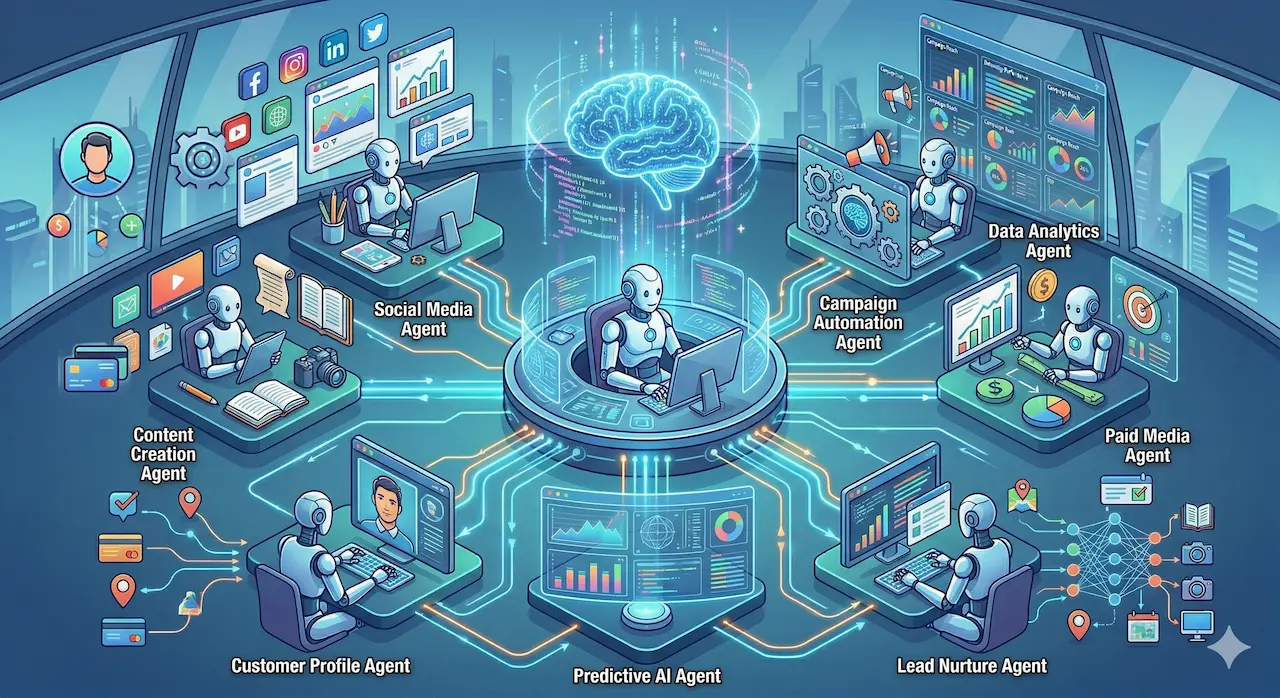
A multi-agent marketing system is an ecosystem of specialized, autonomous AI agents. These agents collaborate to plan, execute, and optimize marketing campaigns with minimal human intervention. Unlike conventional automation, which follows rigid, pre-programmed rules, this new paradigm employs a team of AI agents.
Each agent has a distinct role, such as SEO Analyst, Content Strategist, or PPC Optimizer. They communicate, negotiate, and adapt in real-time to achieve common goals. This system addresses the persistent fragmentation of marketing departments.
Data, insights, and workflows often remain trapped in functional silos. This leads to misaligned messaging, wasted budget, and missed opportunities. A multi-agent framework dissolves these barriers, creating a unified, intelligent entity.
This entity operates with a speed and coherence unattainable by human teams alone. This article provides a definitive blueprint for CMOs and marketing leaders. It details the architecture, strategic advantages, implementation roadmap, and performance metrics for deploying a successful multi-agent marketing system.
Deconstructing the Multi-Agent Marketing System: Architecture and Components
Understanding a multi-agent marketing system begins with its core architecture. This mirrors the structure of a high-performing human marketing department but operates at machine speed. It is not a single piece of software, but a dynamic environment of distinct, interconnected components.
At its foundation are the Specialist Agents. These are individual AI models trained for specific marketing functions. Examples include a Keyword Research Agent, a Creative Agent for ad copy, a Social Media Agent for scheduling, and an Analytics Agent for performance monitoring. Each agent possesses deep expertise in its domain.
The second critical component is the Communication Protocol. This is the shared language and rules agents use to interact. It allows the SEO Agent to pass a high-intent keyword list to the Content Agent, which then generates a brief. This seamless data exchange eliminates manual handoffs and departmental silos.
All interactions are informed by a Shared Knowledge Base. This centralized repository stores brand guidelines, historical campaign data, real-time market trends, and customer personas. It ensures every agent operates from a single source of truth, maintaining brand consistency and strategic alignment.
The entire ecosystem is coordinated by an Orchestrator, often called a marketing super agent. This master agent does not execute tasks itself. It translates high-level business goals into a coordinated action plan, delegates tasks, and resolves conflicts. This ensures the entire system works toward a unified objective.
The Foundational Elements of an Effective Multi-Agent Marketing System
To build a robust system, these components must be clearly defined. Specialist agents are tactical executors. The communication layer acts as the nervous system. The knowledge base is the collective memory, and the orchestrator provides strategic direction.
For example, a goal to “increase webinar sign-ups by 20%” is given to the orchestrator. It tasks the Audience Agent to define the target ICP, the Content Agent to draft promotional copy, the Paid Media Agent to set up campaigns, and the Email Agent to create a nurture sequence.
As performance data flows in, the Analytics Agent reports back to the orchestrator. The orchestrator may then instruct the Paid Media Agent to reallocate budget to the better-performing channel. This dynamic, closed-loop system is core to the effectiveness of a multi-agent marketing system.
The initial step for any organization is to map existing marketing workflows. This identifies discrete roles that can be assigned to specialist agents.
The Strategic Shift to a Multi-Agent Marketing System
The transition to a multi-agent marketing system represents a strategic pivot. It moves from managing fragmented activities to orchestrating a unified marketing engine. The primary driver for this shift is the inherent inefficiency of siloed operations.
Campaigns with tightly integrated cross-channel messaging see a 35% higher ROI than siloed efforts. Yet, most organizations struggle to achieve this coordination manually. SEO insights on ranking keywords often fail to reach the content team before briefs are written.
Paid media data on high-converting ad copy is rarely used to inform email subject lines. This disconnect results in a disjointed customer experience and suboptimal performance. A multi-agent marketing system directly addresses this fragmentation by design.
The system’s architecture forces collaboration. An insight generated by one agent becomes an input for another automatically. For instance, a Customer Insights Agent might detect a surge in social media discussion around a product feature.
This information passes to the Content Strategy Agent, which tasks a writer agent to produce a timely article. Simultaneously, the PPC Agent is alerted to bid on related keywords, and the Social Media Agent schedules posts to amplify the new content. This entire sequence can execute in hours, not weeks.
It transforms the marketing department from separate functions into a single, responsive organism. This organism senses and adapts to market changes in real time.
Overcoming Fragmentation with a Multi-Agent Marketing System
The practical application of a multi-agent marketing system is best illustrated through a product launch. In a traditional model, this involves a series of kickoff meetings, endless email chains, and static project plans.
In a multi-agent model, the Orchestrator Agent receives the objective: “Launch Product X on Date Y with Z pre-orders.” It then decomposes this into tasks for its specialists. The Market Research Agent analyzes competitor positioning, and the Messaging Agent develops core value propositions.
The Creative Agent generates a suite of visual assets and copy. The Channel Agents (Paid, Social, PR) then pull from this centralized repository to execute their specific tactics, ensuring perfect message consistency.
As early performance data arrives, the Analytics Agent identifies which messages resonate most. The Orchestrator immediately instructs all other agents to prioritize and adapt their tactics based on this winning message. This is the essence of a truly agile and data-driven multi-agent marketing system.
The first step for leaders is to identify the most critical and currently fragmented workflow. Designate it as the initial pilot for a collaborative AI approach, such as lead nurturing or content promotion.
The Execution Layer of a Multi-Agent Marketing System: How Collaborative AI Agents Work in Concert
The true power of a multi-agent marketing system is revealed at the execution layer. Here, high-level strategy translates into thousands of coordinated, micro-level actions. This is orchestrated through intelligent task decomposition and iterative optimization.
When a CMO sets a goal like “Reduce customer acquisition cost by 15% in Q4,” the marketing super agent doesn’t just execute a single plan. It breaks the objective down into a tree of sub-goals and tasks. The Paid Media Agent optimizes ad spend, the SEO Agent improves organic rankings, and the CRO Agent increases landing page conversion rates.
These collaborative AI agents do not work in isolation; they constantly share data. For example, the Paid Media Agent discovers ad copy featuring “lifetime warranty” has a 50% higher click-through rate. It broadcasts this finding.
The CRO Agent immediately initiates an A/B test on the landing page, replacing the current headline with the new copy. The SEO Agent checks if this change negatively impacts keyword density and advises on alternatives if needed. This feedback loop, which might take a human team weeks, happens autonomously in minutes.
This allows for continuous optimization. The entire marketing funnel is refined simultaneously based on real-time, cross-channel data.
A Practical Example of a Multi-Agent Marketing System Workflow
Consider a content marketing workflow within a multi-agent marketing system. The process begins with the SEO Strategy Agent identifying a content gap with high traffic potential and low competition. It passes the target keyword cluster and search intent analysis to the Content Brief Agent.
This agent constructs a detailed brief, including recommended headings, semantic keywords, internal linking suggestions, and word count targets. The brief is then sent to a Generative AI Writing Agent, which produces a draft. An Editing Agent subsequently reviews the draft for accuracy, brand voice, and factual correctness.
Finally, a Publishing Agent formats the article for the CMS, adds metadata, and schedules it. The Social Media Agent is then notified to draft and schedule promotional posts. This entire assembly line is automated, turning a multi-day, multi-person process into a streamlined, hours-long operation.
Marketers shift from task-doers to system managers. They define strategic guardrails and approval gates where human judgment is essential, such as final approval of the content brief or the finished article.
The Marketing Super Agent: Orchestrating Your Multi-Agent Marketing System
At the center of any advanced multi-agent marketing system sits the orchestrator, or marketing super agent. This is not merely a project manager; it is the strategic brain of the entire operation. Its primary function is to maintain strategic alignment.
The super agent ensures that the autonomous actions of dozens of specialist agents all contribute directly to overarching business objectives. It holds the master marketing plan, key performance indicators (KPIs), budget constraints, and brand principles.
When a specialist agent proposes an action—for example, the PPC Agent wants to test a new ad platform—the super agent evaluates the request. It checks against the current strategy, budget, and potential ROI before granting approval. This prevents the system from devolving into chaotic, uncoordinated activity.
Another critical function is dynamic resource allocation. The super agent continuously monitors performance data from all channels. If it detects that the Email Marketing Agent generates leads at a far lower cost-per-acquisition than the Display Ad Agent, it can autonomously shift budget.
This reallocation moves budget from the underperforming channel to the high-performing one in real-time. This maximizes overall efficiency without waiting for a weekly performance review meeting. This capability alone can yield significant improvements in marketing ROI.
Key Functions of the Marketing Super Agent in a Multi-Agent Marketing System
The marketing super agent also serves as a conflict resolution hub. Specialist agents will inevitably have competing priorities. The SEO Agent might advocate for a 3,000-word, text-heavy article, while the User Experience Agent argues this creates a poor mobile experience.
The super agent adjudicates these disputes. It weighs the pros and cons based on the primary goal of the specific campaign. If the goal is top-of-funnel awareness, it might side with the SEO Agent. If the goal is bottom-of-funnel conversion, the UX Agent’s recommendation may take precedence.
Finally, the super agent is responsible for synthesized reporting. Instead of five different reports from five different teams, leadership receives a single, coherent dashboard. It translates terabytes of operational data from specialist agents into clear, concise insights on overall progress toward strategic goals.
To begin simulating this function, marketing leaders can create a master dashboard. This manually integrates data from disparate platforms, creating a single source of truth to guide strategic decisions.
A Phased Approach to Implementing Your Multi-Agent Marketing System
Deploying a multi-agent marketing system is a strategic, phased evolution, not a monolithic project. Attempting a “big bang” implementation across an entire marketing organization is high-risk and likely to fail. A more effective method, validated by internal data showing a 63% higher success rate for phased AI adoption, follows a clear, four-stage roadmap.
The journey begins with Phase 1: Audit and Map (Months 1-2). This foundational stage involves meticulously documenting all existing marketing workflows. Identify every data source, tool, and human decision point. The goal is to find areas with the highest degree of repetitive, data-intensive tasks and significant cross-functional friction.
These become prime candidates for initial automation.
Next is Phase 2: Pilot Program (Months 3-6). Select a single, well-defined workflow, such as competitive intelligence monitoring or performance reporting. Deploy a small team of two to three agents to automate just this process. For example, one agent could scrape competitor websites, another analyze sentiment, and a third summarize findings in a daily digest.
Crucially, measure the pilot’s performance against the existing manual baseline to prove its value.
From Pilot Project to Full-Scale Deployment of a Multi-Agent Marketing System
Once the pilot demonstrates clear ROI, proceed to Phase 3: Integration and Expansion (Months 7-12). Here, connect more agents and integrate the system with core business platforms. Examples include your CRM, marketing automation platform, and analytics suite.
The pilot reporting agent, for instance, could now connect to your CRM. This correlates competitor announcements with changes in your sales pipeline velocity. This phase focuses on expanding the capabilities of your nascent multi-agent marketing system and creating more complex, cross-functional workflows.
The final stage is Phase 4: Scaling and Optimization (Month 12+). With a proven, integrated system, confidently roll out the multi-agent framework across additional marketing functions. The focus shifts from technical implementation to strategic optimization, primarily refining the logic and goals of the marketing super agent.
This ensures the super agent makes sound, high-level decisions. This phased approach de-risks the investment, builds organizational buy-in, and ensures the system is built on a solid, data-proven foundation. To understand the technology stack required for each phase, discover multi-agent AI platforms designed to facilitate this structured implementation process.
Beyond Clicks and Conversions: New KPIs for a Multi-Agent Marketing System
The success of a multi-agent marketing system cannot be fully captured by traditional marketing KPIs alone. Metrics like Cost Per Lead (CPL) and Return On Ad Spend (ROAS) measure final output, but not the profound operational efficiencies gained. To quantify the full impact, leaders must adopt new metrics focused on speed, intelligence, and efficiency.
The first key metric is Operational Efficiency Gain, measured as “Manual Hours Saved Per Campaign.” This quantifies the reduction in time your team spends on repetitive tasks. Examples include pulling reports, coordinating handoffs, and managing campaign setup. Tracking this demonstrates immediate cost savings and shows time liberated for strategic work.
Another critical KPI is Decision Velocity. This measures the time elapsed from insight generation (e.g., a spike in CPC) to corrective action (e.g., budget reallocation). In manual operations, this can take days or weeks. A multi-agent system reduces it to minutes or seconds.
Improving this metric directly indicates your marketing’s agility and responsiveness.
Quantifying the Impact of a Multi-Agent Marketing System
Beyond speed, measuring the quality of autonomous decisions is vital. Cross-Channel Lift compares the performance of multi-agent orchestrated campaigns against siloed, manually managed campaigns. This isolates and quantifies the value added by the system’s ability to coordinate messaging and tactics across channels.
Similarly, Resource Allocation Efficiency tracks how effectively the system shifts budget and resources to the highest-performing activities. Instead of just looking at final ROAS, measure the rate of ROAS improvement over a campaign’s life. This demonstrates the system’s learning and optimization capability.
For example, a powerful new metric could be “CPL Optimization Velocity”—the percentage by which the system reduces the CPL in the first 72 hours of a campaign launch. By establishing clear baselines for these new KPIs before implementation, you build an undeniable business case for your multi-agent marketing system.
This moves the conversation from tactical outputs to transformative operational impact.
Multi-agent Marketing System: The Future of Marketing is Autonomous and Collaborative
The adoption of a multi-agent marketing system marks a definitive move from managing campaigns to architecting intelligent marketing engines. This approach breaks down functional silos and enables autonomous, real-time collaboration between specialized AI agents.
It unlocks a level of speed, efficiency, and strategic coherence previously unimaginable.
The core benefits are clear: radical reduction in manual coordination, accelerated decision-making based on unified data, and the liberation of human talent. Marketers can now focus on high-value strategy and creativity. This is not about replacing marketers; it is about augmenting them with a powerful, autonomous team that executes with precision at immense scale.
The journey toward a fully agentic marketing function begins not with a massive technological overhaul. It starts with a strategic commitment to a new operational model. Identify a starting point, launch a pilot, and begin building the future of your marketing organization today.
Frequently Asked Questions
What is the core benefit of Multi-agent Marketing System?
Implementing Multi-agent Marketing System strategically lets organizations scale efficiently, driving measurable ROI and reducing daily friction.
How quickly can I see results from Multi-agent Marketing System?
Initial improvements are visible within 14-30 days. Comprehensive benefits compound over 60-90 days.
Is Multi-agent Marketing System suitable for small businesses?
Yes. Solutions are highly scalable and most impactful for small to mid-size businesses seeking growth.
Is your AI strategy leaking revenue?
Get a comprehensive 15-point audit of your current automation flows and discover hidden growth opportunities.
Ready to Implement Multi-agent Marketing System?
Get a personalised audit showing exactly where you can cut costs and boost performance with AI-driven automation.
Leave a Reply